
Iconography and Symbolism of Brahmā: A Study of an Early Medieval Stone Sculpture
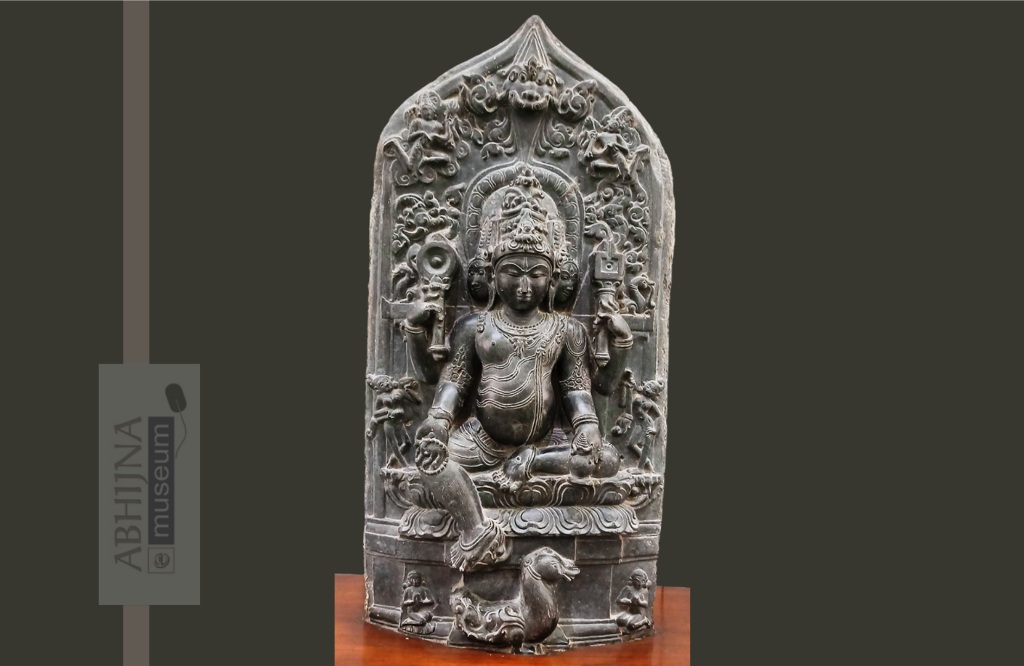
The sculpture depicts Brahmā, the Hindu god of creation and one of the members of the Trimūrti, represented in the refined sculptural idiom characteristic of the Pāla–Sena school of eastern India (c. 10th –12th century CE). Carved from fine-grained black basalt, the image exemplifies the high level of technical craftsmanship associated with early medieval eastern Indian stone sculpture, distinguished by polished surfaces, harmonious proportions and intricate ornamental detailing.
Brahmā is shown seated gracefully in lalitāsana (the posture of royal ease) upon a fully blossomed lotus pedestal, symbolising purity, spiritual creation and transcendence. The deity possesses four faces (Caturmukha), although only the principal frontal face and portions of the lateral faces are visible in the sculpture. The four faces signify Brahmā’s omniscience and his mastery over the four Vedas, the four cardinal directions and the four cosmic ages (yugas). His calm facial expression, with half-closed eyes and a gentle smile, conveys spiritual wisdom and contemplative serenity.
The deity is four-armed (Caturbhuja). The upper right hand holds a cakra (discus), while the upper left hand carries a kamaṇḍalu (water pot), both attributes symbolising cosmic creation and the life-giving waters from which the universe emerged. The lower right hand is extended in Varada-mudrā, the gesture of beneficence and divine grace, while the lower left hand supports a manuscript or sacred object, representing the Vedas and Brahmā’s role as the source of sacred knowledge. Although some attributes may have suffered minor damage over time, the iconographic programme remains largely intact and clearly identifies the deity.
Brahmā wears an elaborate kirīṭa-mukuṭa (high conical crown), richly ornamented necklaces, armlets, bracelets and a sacred thread (yajñopavīta) that crosses the torso. The elegantly draped lower garment (dhotī) is rendered with delicate incised folds, reflecting the sculptor’s mastery in depicting textile forms in stone. The refined anatomical modelling, particularly of the torso and limbs, demonstrates the idealised aesthetic principles that characterise Pāla-period sculpture.
The arched prabhāvali (back-slab) surrounding the deity is richly decorated with scrolling foliage, celestial motifs and attendant figures. Flying vidyādharas or celestial beings occupy the upper corners, symbolising the divine realm and honouring the creator god. Miniature attendants and decorative motifs enrich the lower register, while the pedestal incorporates a haṃsa (swan), Brahmā’s traditional vāhana (vehicle). The swan, renowned in Hindu philosophy for its ability to distinguish between milk and water, symbolises wisdom, purity, and spiritual discernment, qualities closely associated with Brahmā, the embodiment of knowledge and creation.
References (Harvard Style)
Harle, J.C. (1994) The Art and Architecture of the Indian Subcontinent. 2nd edn. New Haven, CT: Yale University Press.
Huntington, S.L. (1984) The Pāla-Sena Schools of Sculpture. Leiden: E.J. Brill.
Kramrisch, S. (1946) The Hindu Temple. 2 vols. Calcutta: University of Calcutta.
Michell, G. (1988) The Hindu Temple: An Introduction to Its Meaning and Forms. Chicago: University of Chicago Press.
Pal, P. (1986) Indian Sculpture: Volume I, Circa 500 BC–AD 700. Los Angeles: Los Angeles County Museum of Art.