
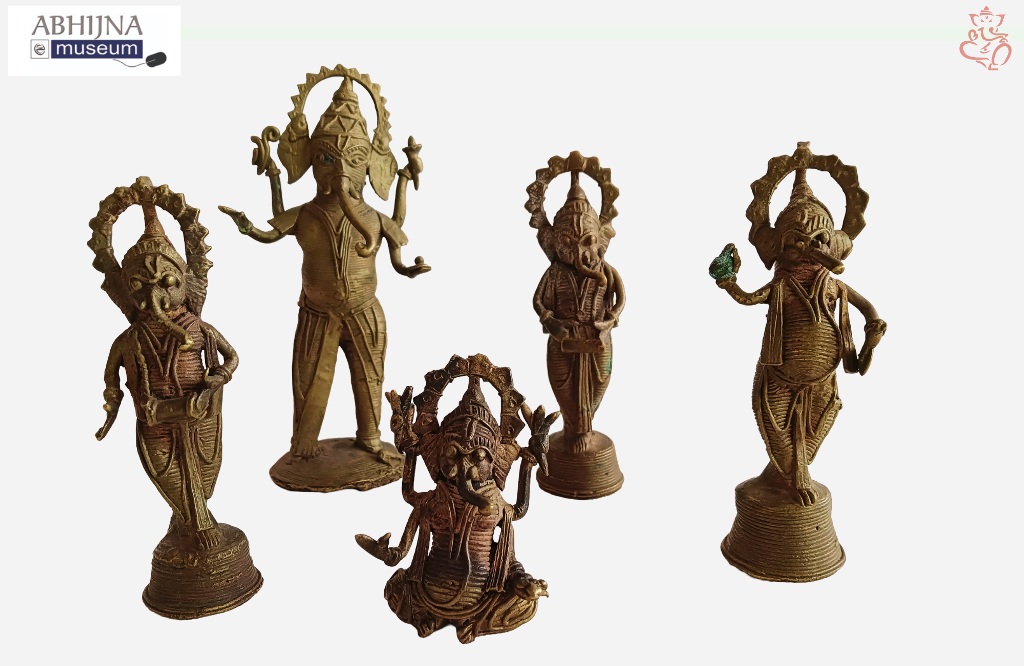
Ganesha: Iconography, Myth and Religious Significance
Ganesha, also known as Gaṇapati, Vināyaka, and Vighneśvara, holds a distinctive place in the Hindu pantheon as the deity of auspicious beginnings, wisdom, intellect, and the removal of obstacles. His worship is traditionally associated with important undertakings, and he is particularly revered in intellectual and creative pursuits. The Getty Cultural Objects Names Authority identifies him as the elephant-headed god of beginnings and a patron of intellectuals, scribes and authors.
Iconography:
The characteristic image of Ganesha combines a human body with an elephant head, a distinctive form that became established in Indian sculptural traditions by the Gupta period. Early surviving examples indicate that his iconography developed gradually; the fifth-century image from Bhumara in Central India is among the earliest securely identifiable representations of the fully developed elephant-headed deity. Early images may have been two-armed, while four-armed forms later became common.
Ganesha is generally represented with a large belly (lambodara), broad elephantine ears and a single visible tusk (ekadanta). His multiple arms may hold objects such as the pāśa (noose), aṅkuśa (elephant goad), broken tusk, modaka (sweet) or other ritual attributes. His vāhana, or vehicle, is the mouse (mūṣaka), which appears as an important element of his mature iconography. The sacred thread may be represented in conventional Brahmanical form or as a serpent, while the serpent can also occur as a girdle around his abdomen.
These attributes carry symbolic associations. The elephant head suggests strength, intelligence and discrimination, while the broken tusk is connected with several mythological traditions and has become one of Ganesha’s defining attributes. The mouse, despite its small size, is understood within the image’s symbolic structure as a being capable of penetrating confined spaces, complementing Ganesha’s role as one who overcomes impediments.
Mythological Traditions:
Ganesha’s origin is narrated in several Purāṇic and later textual traditions, and no single birth narrative accounts for all aspects of his mythology. One widely known legend describes him as the son of Śiva and Pārvatī. According to the popular narrative, Pārvatī created Ganesha and appointed him to guard her dwelling. When Śiva encountered the young guardian and was prevented from entering, a confrontation followed in which Ganesha was decapitated. At Pārvatī’s insistence, Śiva restored him to life with an elephant’s head and acknowledged him as his son. Getty’s study demonstrates that different textual traditions preserve substantially different versions of Ganesha’s birth and transformation.
Another important myth concerns his broken tusk. Different traditions associate it with his confrontation with the Moon, his encounter with Paraśurāma, or his role as the scribe who wrote down the Mahābhārata. Such variations illustrate the richness and fluidity of Ganesha’s mythology. His numerous forms and attributes also expanded considerably as Tantric and Ganapatya traditions developed.
Thus, Ganesha’s iconography represents a synthesis of myth, religious symbolism and evolving artistic conventions. His elephant-headed form, multiple attributes, mouse vehicle and association with auspicious beginnings have made him one of the most recognisable and widely represented deities in South Asian art.
References / Bibliography:
- Getty, Alice. Gaṇeśa: A Monograph on the Elephant-Faced God. 2nd ed. New Delhi: Munshiram Manoharlal, 1992.
- Getty, Alice, and Alfred Foucher. Gaṇeśa: A Monograph on the Elephant-Faced God. New Delhi: Munshiram Manoharlal, 1971.
- Getty Research Institute. Cultural Objects Names Authority: Ganesha (Hindu deity).
- Brown, Robert L., ed. Ganesh: Studies of an Asian God. Albany: State University of New York Press, 1991.