
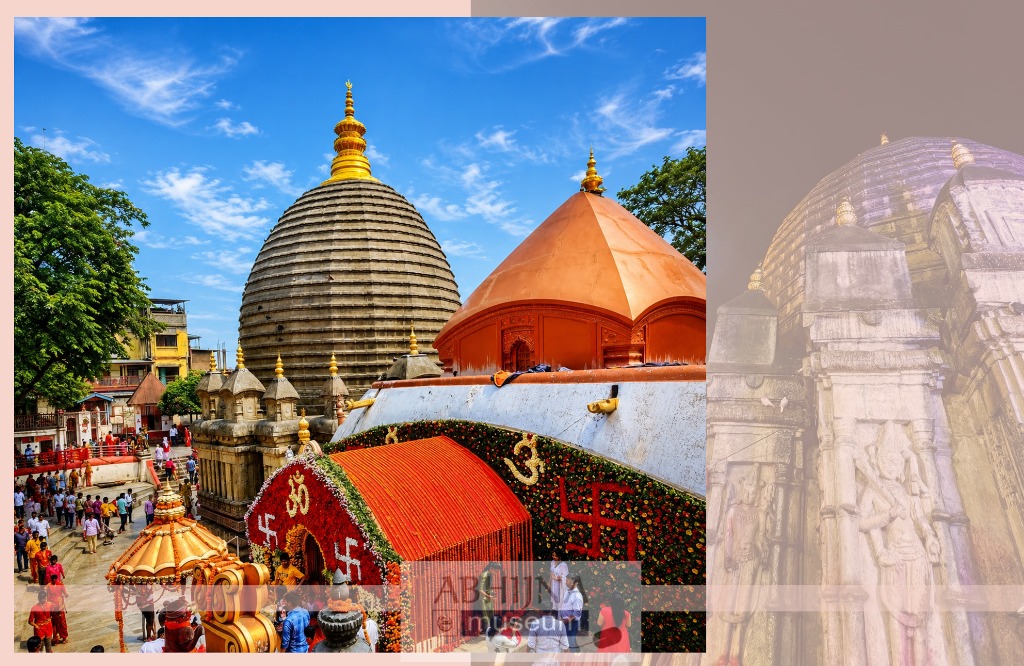
Kamakhya: Shrine of the Divine Feminine
Situated atop Nilachal Hill in Guwahati, the Kamakhya Temple is among the most revered centres of goddess worship in South Asia. Dedicated to Goddess Kamakhya, the shrine holds a distinctive position in the religious and cultural history of Assam and the broader Indian subcontinent. It is recognised both as a major Shakti Peetha, a sacred site associated with the Goddess, and as a significant centre for Tantric worship and pilgrimage.
Central to Kamakhya is the concept that the feminine is worshipped not only as a deity but also revered as the source of creation, fertility, transformation, and cosmic energy. This perspective is most visibly expressed in the annual Ambubachi Mela, a festival that commemorates the Goddess’s ritual menstruation and honours the regenerative rhythms of nature. Through myth, ritual, landscape, and ongoing practice, Kamakhya articulates a sacred vision in which body, earth, and divinity are fundamentally interconnected.

Nilachal Hill- Landscape of Pilgrimage and Power:
Nilachal Hill, which rises above the Brahmaputra valley, serves as the sacred setting for the Kamakhya Temple and its associated rituals. Beyond its geographical significance, the hill is regarded as a spiritually charged landscape shaped by myth, pilgrimage, and centuries of devotion. Its pathways, shrines, water sources, and elevated terrain collectively create an environment where the natural and the sacred are inseparable.
For devotees, Nilachal Hill is not simply the temple’s location but constitutes an essential aspect of the shrine’s sacred identity. The ascent to the hill functions as a pilgrimage, engaging worshippers in ritual preparation and spiritual encounter. During the Ambubachi Mela, the hill is transformed into an expansive ceremonial landscape, populated by pilgrims, ascetics, ritual specialists, and visitors who participate in one of India’s most distinctive festivals dedicated to the divine feminine.

Kamakhya and the Shakti Peetha Tradition:
Kamakhya is regarded as one of the most significant Shakti Peethas in the Indian subcontinent, sanctified through the mythology of Goddess Sati. According to tradition, following Sati’s death, parts of her body fell across the land, imbuing each location with sacred presence. Kamakhya is believed to be the site where her yoni, or generative womb-space, came to rest, establishing the shrine as a powerful centre of goddess worship.
This association informs Kamakhya’s theological identity as a shrine dedicated to fertility, creation, and feminine power. The temple’s rituals and symbolism are thus grounded not solely in the worship of a sculpted image, but in the veneration of the creative principle itself. Within this sacred geography, the Goddess’s body is understood as inseparable from the earth, and the shrine is recognised as a site where cosmic creation, sexuality, fertility, and spiritual energy converge.

Kamakhya Temple: Architecture, Worship, and Sacred Presence:
The current form of the Kamakhya Temple reflects successive phases of reconstruction, patronage, and regional architectural traditions. Over the centuries, the shrine has developed as both a place of worship and a significant cultural landmark, shaped by royal patronage, pilgrimage networks, and the devotional practices of Assam. Its architectural features, including a distinctive dome-like superstructure and intricate sculptural detailing, distinguish it as one of the most recognisable temple sites in the region.
However, the spiritual centre of Kamakhya does not reside in a conventional idol. Within the sanctum, the Goddess is venerated in the form of a natural stone cleft, which is continually moistened by the waters of an underground spring. Revered as a manifestation of the yoni, this sacred form reinforces the shrine’s profound association with fertility, creation, and the generative force of the divine feminine. The absence of an anthropomorphic image distinguishes Kamakhya and highlights its unique ritual identity.

The Divine Feminine and the Sacred Body:
Kamakhya represents a sacred vision in which the female body is regarded as a locus of creative power rather than as a site of concealment or impurity. The shrine’s central symbolism emphasises the feminine as the source of birth, nourishment, desire, and transformation. Within this conceptual framework, the body of the Goddess is not separated from earthly existence but is closely connected to the cycles of nature, fertility, and the rhythms of life.
This perspective is particularly significant in the context of menstruation. At Kamakhya, menstruation is honoured as a life-giving process and an indicator of regenerative potential. The annual observance of the Ambubachi Mela embodies this worldview by recognising the Goddess’s menstruation as a sacred event. Consequently, the festival provides a distinctive theological and cultural perspective in which biological cycles are not marginalised but are elevated to the realm of ritual, devotion, and cosmic symbolism.

Kamakhya as a Centre of Tantric Practice:
Kamakhya has long been recognised as one of the principal centres of Tantric worship in South Asia. Tantric traditions associated with the shrine conceptualise the divine as an immanent force present within the body, the natural world, and the energies that animate existence. Rather than separating spirit from matter, these traditions emphasise transformation through embodied practice, ritual discipline, meditation, and the cultivation of inner power.
Within this context, Kamakhya is recognised as a site where the Goddess is experienced not only as an object of devotion but also as an active, dynamic force of creation and transformation. The shrine has historically attracted ascetics, ritual specialists, and practitioners from various lineages. During the Ambubachi Mela, these communities become particularly prominent, assembling at Nilachal Hill to engage in rituals, observances, and acts of spiritual discipline that affirm the temple’s enduring significance within the Tantric tradition.

Ambubachi Mela: Festival of Fertility and Renewal
The Ambubachi Mela is the most widely recognised annual festival associated with the Kamakhya Temple. Observed during the Assamese month of Ahaar (mid-June), it commemorates the ritual menstruation of Goddess Kamakhya and celebrates fertility, regeneration, and the creative energies of the feminine. The festival coincides with the onset of the monsoon, a seasonal transition that further reinforces its association with abundance, renewal, and the earth’s fecundity.
Deeply rooted in regional belief and Tantric practice, the mela transforms Kamakhya into a major site of pilgrimage and collective devotion. For several days, Nilachal Hill serves as a gathering place for pilgrims, ascetics, Tantric practitioners, traders, and visitors from across India. Through ritual closure, ceremonial reopening, and large-scale participation, the Ambubachi Mela gives tangible expression to Kamakhya’s central theological concept: that the rhythms of the female body and the fertility of the earth are sacred and life-sustaining.

Ritual Seclusion- Closure:
A defining aspect of the Ambubachi Mela is the temporary closure of the temple’s innermost sanctum for the first three days of the festival. This period marks the Goddess’s annual menstruation and is regarded as a time of sacred seclusion, withdrawal, and renewal. The closure of the sanctum does not indicate absence; instead, it signifies an intensification of divine potency, during which the Goddess is believed to rest in her creative and fertile state.
During these three days, devotees engage in prayer, fasting, restraint, and contemplation. The atmosphere of the festival is characterised by expectancy and reverence as worshippers await the reopening of the shrine. The ritual closure thus serves as one of the most significant symbolic acts of the festival, providing sacred expression to menstruation as a generative force and linking the Goddess’s body to the fertile rhythms of the monsoon season.
Revelation and Return: Reopening of the Shrine
On the fourth day of the Ambubachi Mela, the sanctum of Kamakhya is ceremonially reopened. This event marks the culmination of the festival and is met with intense devotional fervour. Ritual observances, offerings, and public celebrations accompany the reopening, as pilgrims assemble to receive the Goddess’s blessings following her period of seclusion.
The reopening of the shrine signifies renewal, abundance, and the restoration of direct access to Kamakhya’s sacred presence. For many devotees, this is the most significant moment of the festival, imbued with spiritual anticipation and grace. The event attracts large crowds to Nilachal Hill, where the Goddess’s return to public worship is experienced as both a ritual conclusion and a reaffirmation of life, fertility, and divine continuity.
Pilgrims, Ascetics, and Living Traditions:
The Ambubachi Mela functions not only as a temple festival but also as a major gathering of religious communities and devotional publics. Pilgrims travel from Assam and distant regions of India to participate in the mela, offer prayers, and receive blessings. Alongside them are ascetics, mendicants, Tantric practitioners, and spiritual lineages whose presence contributes to the festival’s distinctive visual and ritual character.
This convergence produces a dynamic cultural landscape in which diverse forms of devotion, practice, and performance coexist. Temporary camps, ritual spaces, offerings, recitations, and acts of public worship transform the temple precinct into an active field of sacred exchange. The mela thus embodies both continuity and diversity: it is simultaneously a deeply local observance rooted in Assamese tradition and a major pilgrimage event that unites varied communities of faith.
Monsoon, Fertility, and the Rhythms of the Earth
The timing of the Ambubachi Mela is intrinsically linked to the seasonal context in which it occurs. Celebrated in Ahaar, around mid-June, the festival coincides with the onset of the monsoon in Assam. This period of rainfall, agricultural renewal, and environmental transformation imbues the mela with symbolic depth. The earth, revitalised by water and prepared for growth, reflects the festival’s central themes of fertility, regeneration, and creative power.
Within this seasonal context, the Goddess’s menstruation is interpreted not as an isolated ritual event but as part of a broader cosmological rhythm connecting body, land, and life. The sacred spring within the shrine, the rain-bearing skies, and the fertile landscape collectively reinforce Kamakhya’s identity as a temple where nature and divinity are closely intertwined. The festival thus serves as a ritual meditation on renewal, encompassing both human and ecological dimensions.
Kamakhya and the Sacred Imagination of Renewal:
Kamakhya occupies a unique position at the intersection of myth, landscape, ritual, and lived faith. Its sacred power derives not only from its antiquity or theological significance but also from its ongoing influence on conceptions of femininity, fertility, embodiment, and divine presence. Through the Ambubachi Mela, the shrine articulates a distinctive ritual language in which menstruation, earth, and creation are integrated within a shared sacred framework.
For generations of devotees, Kamakhya has remained a place of pilgrimage, transformation, and blessing. For cultural history, it offers a remarkable example of how regional traditions, Tantric practice, and goddess worship converge to create a distinctive religious world. In honouring the creative power of the feminine, Kamakhya invites reflection on the body as sacred, the earth as life-bearing, and renewal as one of the most enduring themes of human devotion.
Image courtesy: Samudra Deka, Darrang & Nancy Deka, Guwahati