
Carved from Pith: The Living Tradition of Sholapith in Assam
Sholapith is one of the finest and living traditions of craft making practised by the Malakars or Bhuimali community residing in different parts of present day Goalpara and Dhubri district in Assam. The Sholapith craft is made from Shola or Kuhila, a plant which grows in the marshy waterlogged areas. The scientific name of this plant is Aeschynomene Aspera and is an herbaceous plant. The white, corky pith of this shrubby tropical legume is called sola in India growing up to 3 mtr in height. The main part of the plant which is used for making decorative items, painting surfaces etc is the cortex, the inner soft-white and fibrous part.
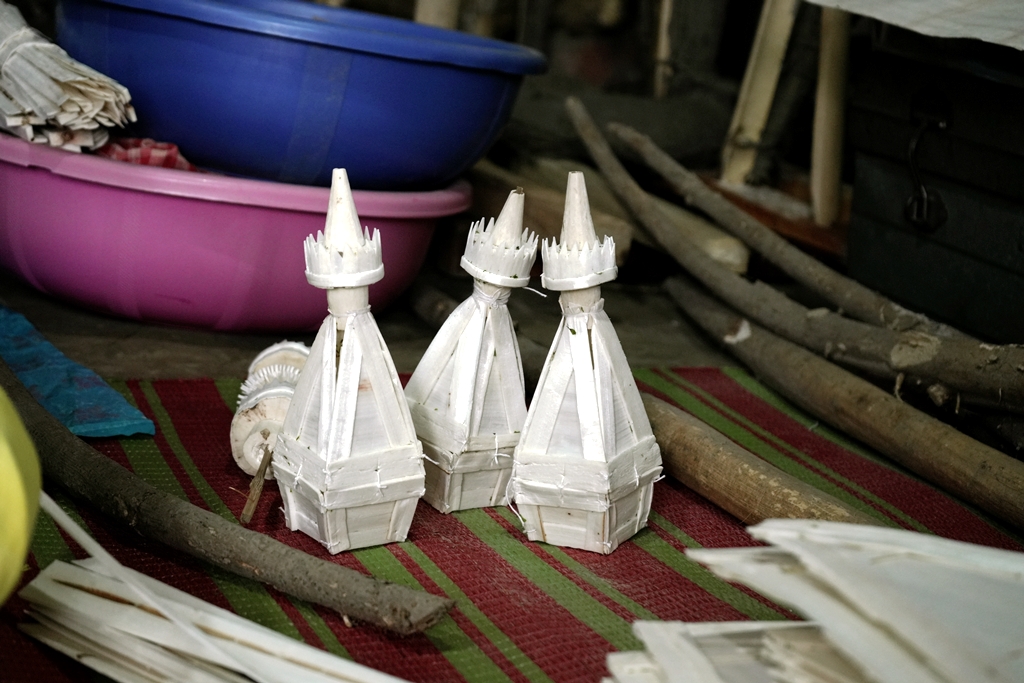
In Assam, Sholapith craft is also known as Kuhila Shilpa. Families from the parts of Kherbari, Jhaspusabari and Shernagar Gaon Panchayat in Dhubri district are associated with it. Kuhila craft is associated with the making of illustrative patas, local folk gods and goddesses, ornaments, flowers and other decorative items. The artworks not only present religious subjects but also products are manufactured to be used in interiors of houses and temples during various ceremonies like marriages and festivals. During the time of celebration of local festivals by the Rajbongshis, like Kati bihu(a harvest festival celebrated in the month of October), Manasa Puja (celebrated in respect to goddess Manasa, the serpent), Bash Puja(bamboo festival), Charak Puja (celebrated to satisfy God Siva) and many more, the deities made of kuhila are worshipped and painted masks are worn for performance.
The kuhila made ornaments are also adorned by dancers while performing various folk dances like Kushan Nritya, Hudum Nritya, Kali Nritya, Sonarai Nritya, Chandi Nritya, Goalini Nritya and many more. Headgears called the Topar are also made for the bride and groom of Rajbanshi families.

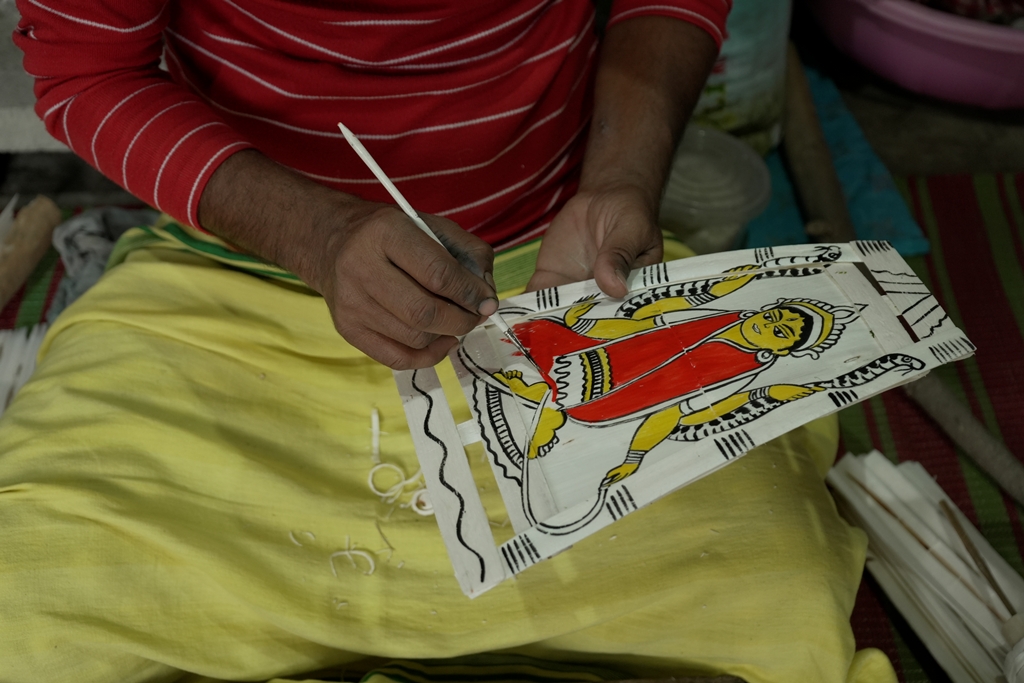
The local artisans of western Assam who create these delicate pith objects are known as Malakars. Renowned as gifted folk artists, they possess remarkable skill in depicting folk characters, narrative episodes, and divine figures from the Hindu pantheon on patas crafted from shola. With sensitive brushwork and a refined sense of colour, they bring these sacred and cultural themes to life, transforming simple pith into vibrant expressions of devotion and storytelling.
In the undivided Goalpara region, although the craft of Sholapith is primarily connected with Manasa worship, it has a much broader base and is more intimately associated with folk life.
In the books “The meaning of Art” by Herbert Read and “Primitive Art” by L.Adam, it is mentioned that the paintings on pith possesses all the characteristics of Peasant Art, meaning it reflects the art of the peasant population of the civilised countries of today compared with sophisticated arts in urban centres, it is apparently primitive.
However, in the book “An Account of Assam” Francis Hamilton records that apart from the Malakars, a section of other castes such as Kalitas and others are also involved in the making of garlands and artificial flowers from shola.
The folk artists produce two different types of art forms
- Painted 3-D images of gods and goddesses
- Independent Paintings on flat surface
Verrier Elwin in his book “Folk Paintings of India”, 1961, termed it as “an unlikely medium”, which has most unexpectedly attractive results. He was of the opinion that though some work on pith is done in other parts of the Indian subcontinent, but nowhere else do the pith artists produce such a large variety of articles, including paintings that are found in the lower Assam district of erstwhile Kamrup and Goalpara, particularly the later. Reason being the naturally available raw materials, ie the reed growing abundantly in the many swamps here.
In the “Goalpara District Gazetteer, 1905, B.C Allen has mentioned that Toys made of Sholapith by Malakars and a few Rajbangshis are found in the parganas of Ghurla, Jamira, Parbotjoar, Khuntaghat and Kalumalupara.
Origin, Technique and Painting style:
Origin and Associated Myth: Sholapith craft originated in the easternmost part of India. These craft products are mainly used for religious purposes and have a mythological story associated with its evolution. Legend says that a celestial dancer named Solabati had fallen in love with Banasur, a demon in the court of Indra. Indra was not very happy with Sholabati’s show of affection towards the demon so he cursed her by transforming her into Shola reed. Solabati asked forgiveness to lord Indra and in return as an act of mercy Indra altered the curse by saying that only in the hands of the Malakars or the garland makers she will be purified and that she will not be useful to others. Thus, till today the Malakars before they start to prepare the garland of Sholapith they stuck the Shola with a stick and put it in the water, believing that she is being reunited with Banasura.
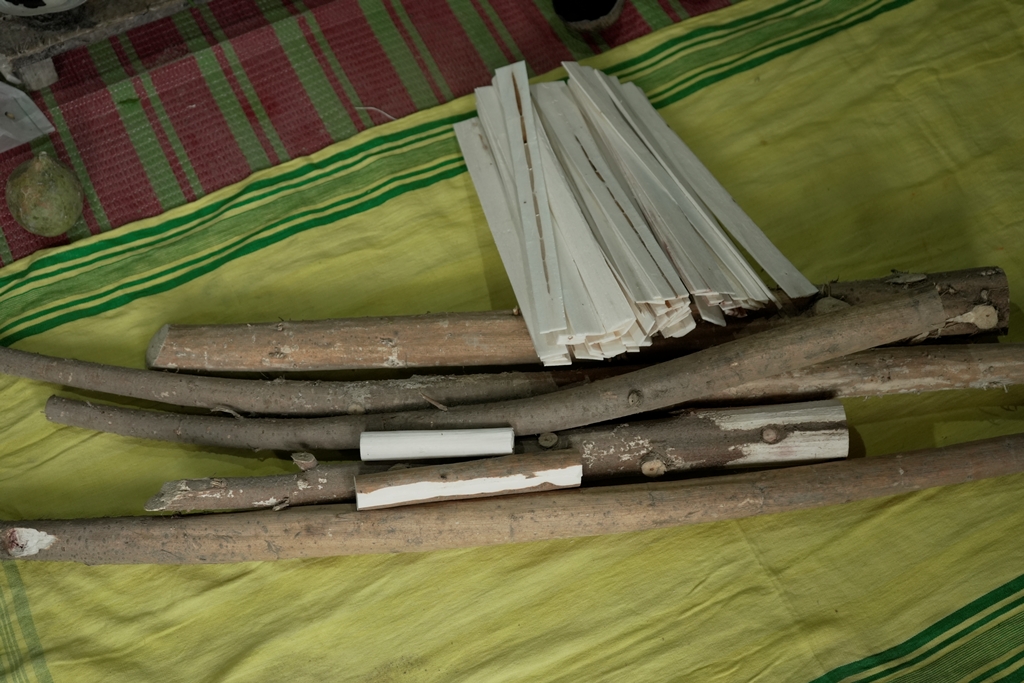
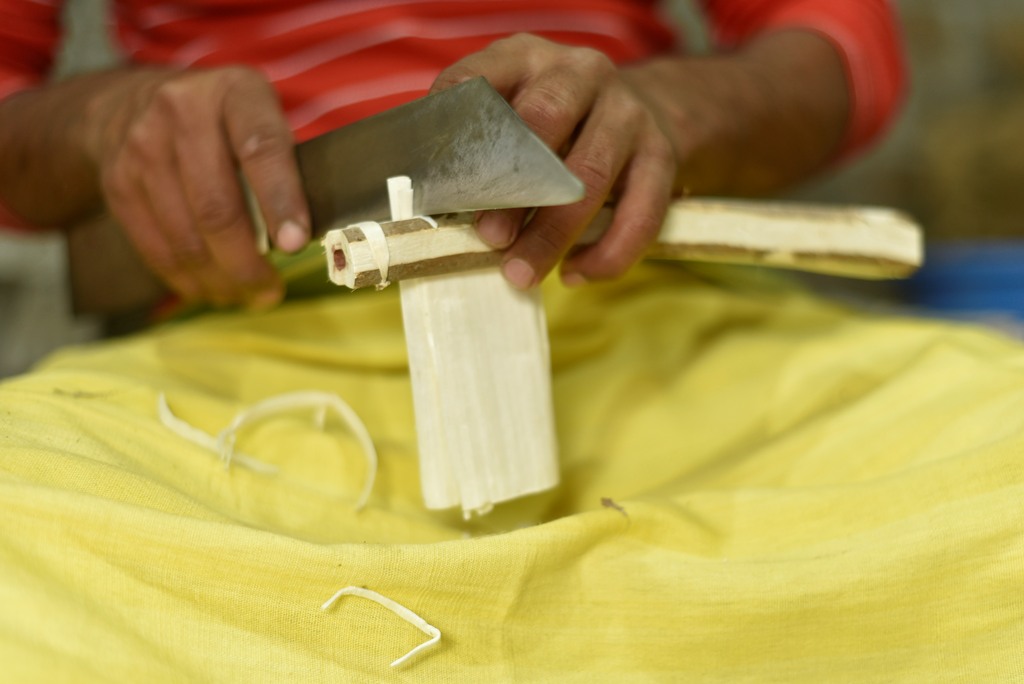
Technique: This particular plant grows mainly in marshy areas in western Assam. The seeds of this plant germinate with the start of the showers from April and mature by September / October. These are collected and dried in the sun for 4 to 5 days, after which the leaves are cut and the stem is taken for crafting.
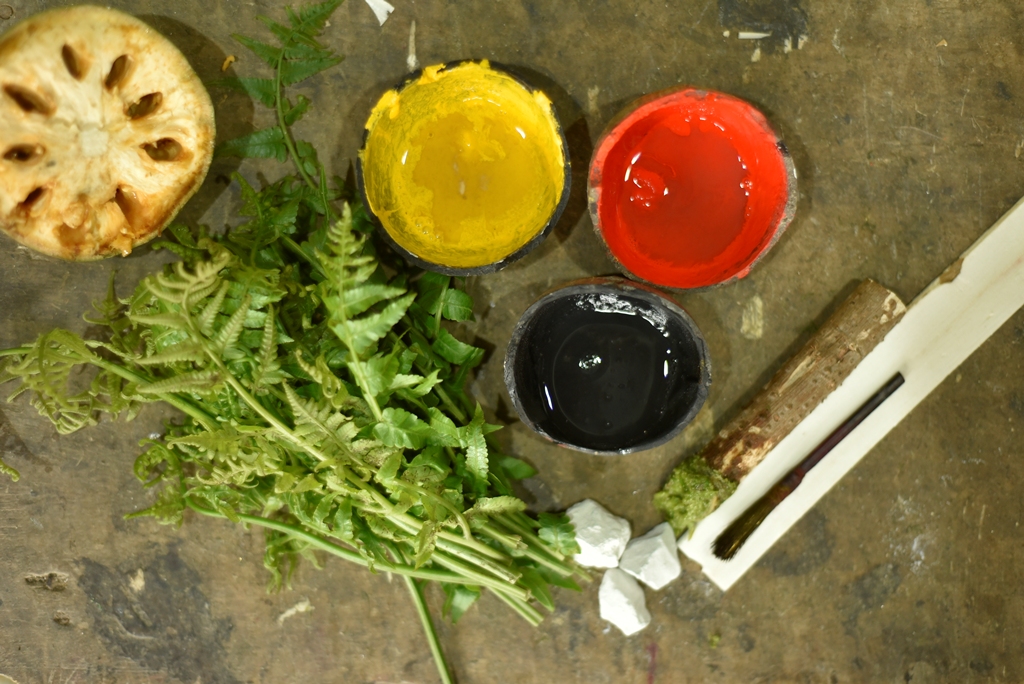
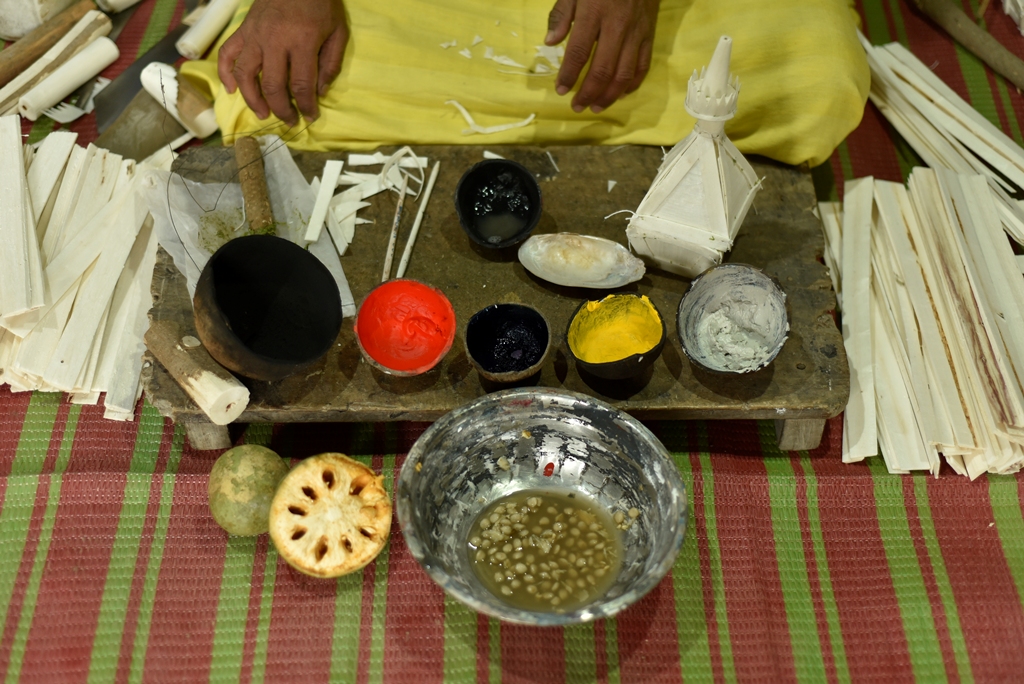
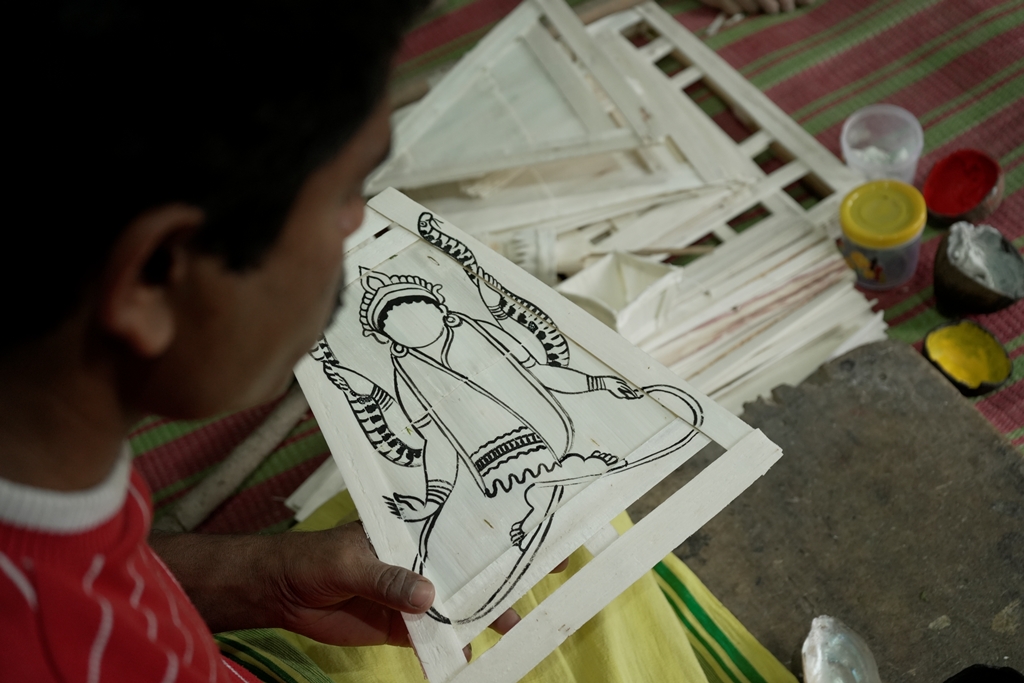
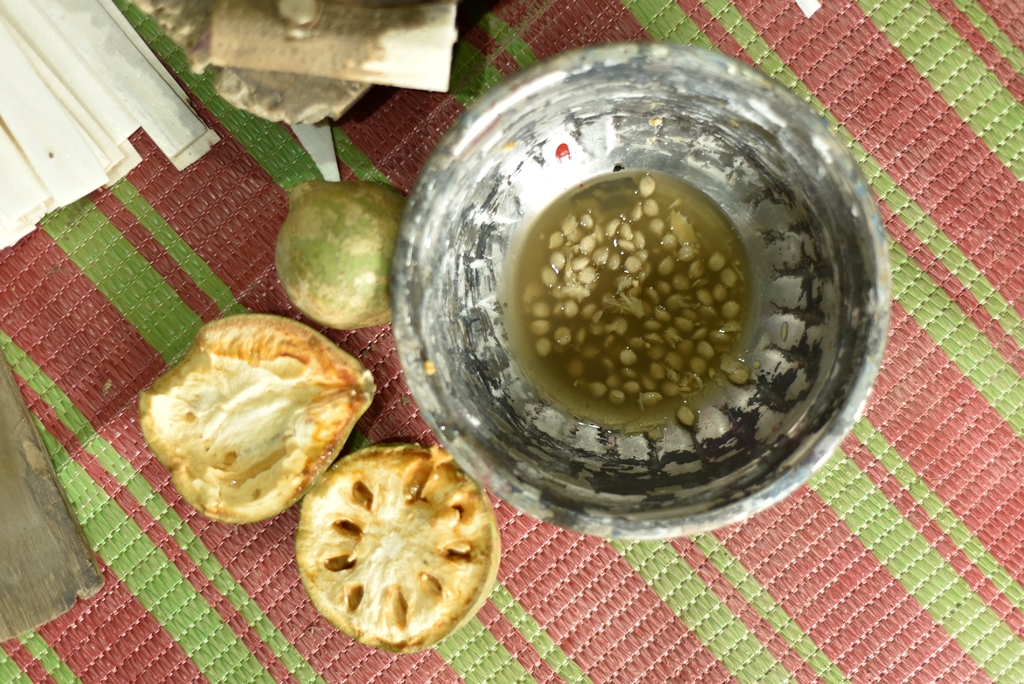
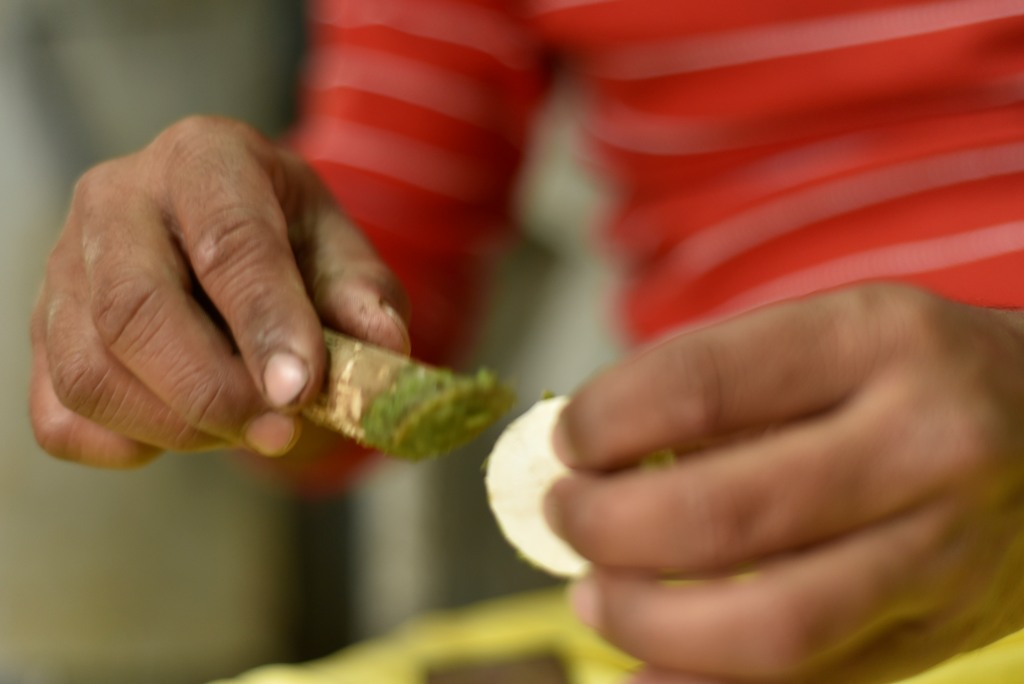
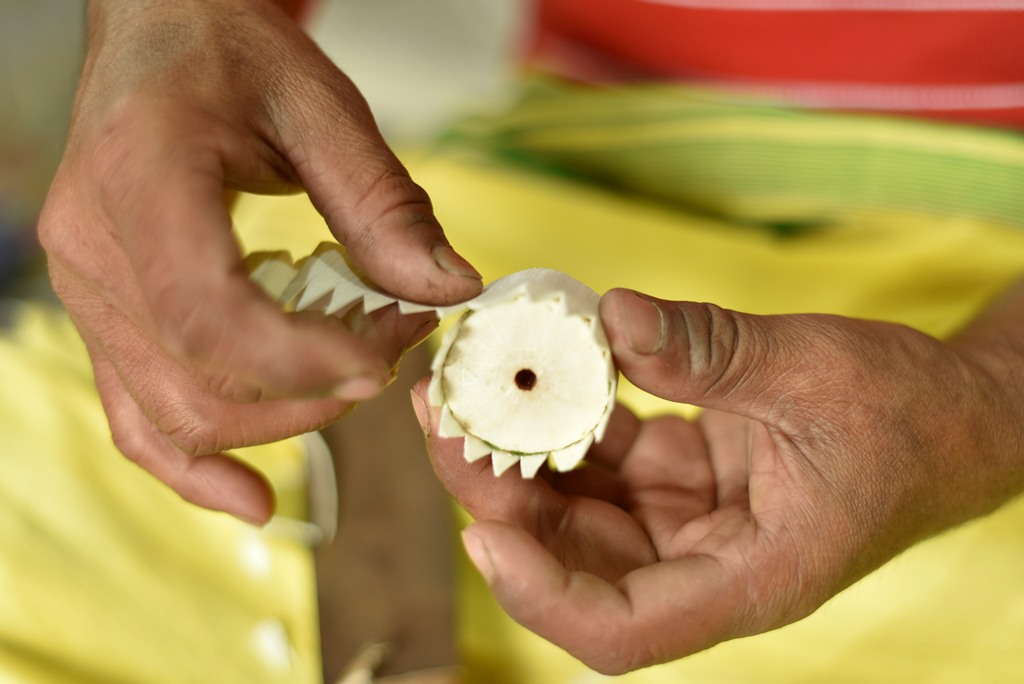
The second stage includes peeling of the inner soft light, lustrous potion which looks like ivory to be used by the artisans. The stem of the plant is cut into 3 to 8 parts according to the needs of the artisan. Then with the help of a sharp knife long sheets in thin slices are cut out moving the knife in circular motion. These fine sheets are pasted on papers to give extra support. Also, additional attachments are stuck to the main body with the gum paste made from grinded fiddlehead fern (diplazium esculentum). The rough part is smoothed out with a chaeni. Natural colours extracted from plants, soot, flowers etc are used to paint the 3-d craft objects and the pata.
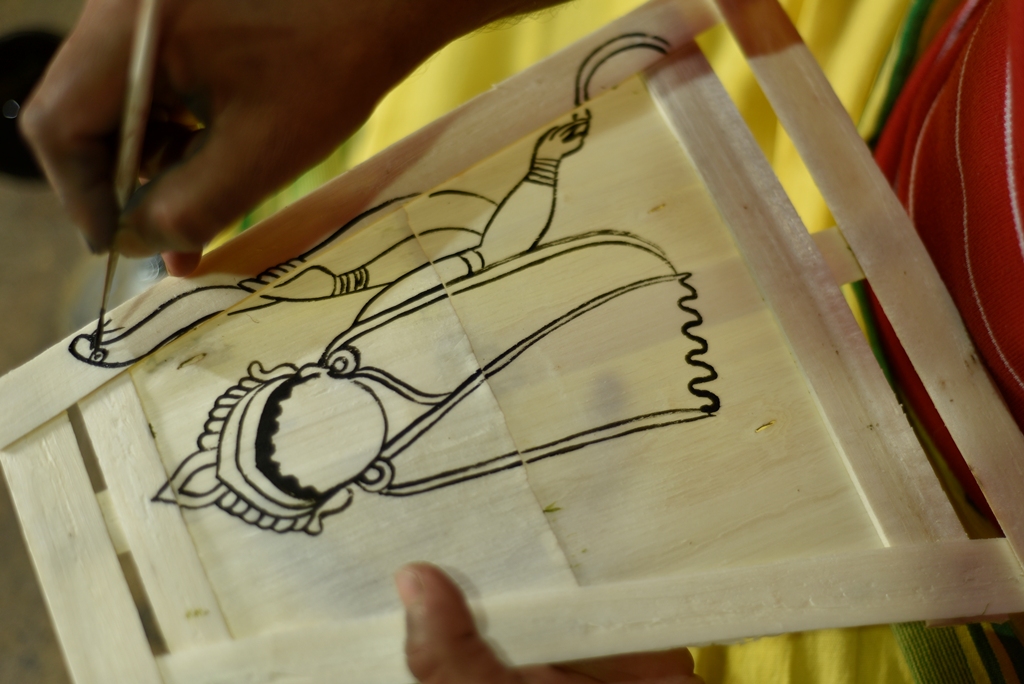
Painting Style: The Folk artists are generally not concerned with realistic representation of the subjects but their images are depicted in delightful conventional patterns determined by both the natural qualities of the material used and the acquired traditional skill of painting. In the paintings, lines predominate and colour is being applied to an outlined surface. There is no use of the idea of perspective in the drawings and no variation in tones either. The images, especially the “Bishohori Pats” are designed on a triangular conception and the flow and grace of the curves of some Bishohori paintings are particularly vibrant. The artist first draws the outline of the images and then it is filled with bright primary colour only. Sometimes, fine lines are applied on the painted surfaces to bring out details. The use of colour is flat and there is no variation in tone. In some patas, there is not much landscape except the occasional suggestion of water, moon, clouds etc. It has an unmistakable folk character and in some ways they have a close resemblance with that of the pat paintings of Bengal.
Religious context: Tradition and Change
The artists of Kuhila skillfully use the flattened pith sheets as ‘canvas’ to render real paintings on the subjects of local deities, mythological stories, and themes from the Epics and Puranas.
Religious beliefs and practices constitute the main source of inspiration for pith painting and its use. Nowadays secular themes also come in. However, the pith patas made with religious subjects have a direct link with the religious and semi religious beliefs and practice of the community. The most specific and intimate connection of the pith artists is with the widely popular cult of serpent goddess Manasa, who is locally known as Bishohori
Rituals and beliefs centring on the worship of the snake goddess manasa, known as marai puja provide one of the most extensive fields of work and the most substantial sustenance to the pith artists. During the ceremony a shrine shaped pith structure known as mandus or maju is being made by the pith artists with paintings on it drawn from the subjects of the popular legend of Beula Lakhindar. The artists take the maju as the canvas and narrate the conflict of the goddess and the merchant chando through detailed painting using bold lines and vibrant colours. The scenes also depict Chando’s voyage; of Beula floating on a raft with the body of her dead husband; of Netai, the celestial washer-woman with whose help Beula gets back her husband and brothers-in-law and so on.
The conventional descriptions of the pictures painted include both major gods of the great tradition as well as minor ones of the local little tradition. Some of the local gods and goddesses mentioned are: Airani, Ghateswari, Chandideb, Dhankuber, Bira-Birani, Ghar-Gosani, Langa and Jara. It is interesting to note that the folk iconography conforms to the local folk beliefs rather than to the sanskritic prescription. For example, Lakshmi and Saraswati are presented as mounted not on the owl and the swan, their recognised vehicles, but on the pigeon and the centipede respectively. In some major paintings, Brahma is depicted as standing on a bamboo tray filled with paddy husk. In the local folk tradition, Brahma is identified with agni, and since fire is believed to stay in the hearth in heaps of paddy husk Brahma finds himself placed on this unusual pedestal.
The pith workers also produce independent sheets of paintings or pats, which are not part of the majus but independently depicted with themes taken from the Puranas and legend used for religious and semi religious purposes. The Bishohori pats are widely produced by the artists among other subjects.
Other important and popularly produced subjects are the Navagrahas or the nine planets. Although the navagraha subjects were not directly linked to the folk religious practice and beliefs in the area, but due to opening of a commercial market space for such works, the pith artists produce remarkable paintings representing the nine planets making full use of the traditional technique and style.
In recent years, a considerable change in depiction of the paintings in the majus has been noticed. The artists deviate from the traditional themes and more contemporary subjects are adopted to paint the majus. The artists portray subjects taken from the contemporary lives of people such as boys and girls decked in trousers, shirts, skirts etc, instead of the religious subjects of manasa, beula lakhinder etc. Another noticeable change is seen is the use of materials. In place of pith sheets, often white papers are used to make the paintings. The Artists now rely much on the enamel paints that are easily available in the market, instead of preparing the natural colour pigments. Also, the traditional style is now being replaced by the calendar style of painting. As Birendranath Dutta puts it, these changes represent the influence of mass culture on folk art forms.
The pith artists used to receive orders for objects related to the religious beliefs and practices- which include a class of paintings. However, in recent years for many reasons there has been a substantial decline in these orders. Also, the patronage formerly used to receive from the zamindars has in recent years shrunk to alarming degree.
Conclusion:
A.K.Haldar, in his book Folk-Art has mentioned that in the whole of Assam, today it is only in Goalpara (undivided) that a living and vigorous tradition of Folk painting is being maintained by the Malakars or Phulmalis, who still wield their brushes with excellent effect to decorate the numerous images and toys shaped out of pith by themselves and also to execute independent works on “canvases” of flattened pith.
These uniquely artistic works appeal to the onlooker’s eyes and display the true craftsmanship of these local artisans who are till today preserving this precious art form. This craft claims a superiority and popularity due to its artistic expressiveness and fineness. This is the main reason why this craft is considered so special to be used only for religious and auspicious ceremonies. But, with the introduction of modern technology and favoritism to factory made products like thermocol and plastics this rare artwork is on the verge of extinction. The families who at one time took pride and were honoured for producing such beautiful artworks are now facing poverty and forced to look out for other job prospects to earn their livelihood. As this art requires great skill and experience with correct choice of design and intricacy mastered by the great skilled craftsmen, efforts should be made to conserve and practice to keep alive the beauty of this Sholapith Craft.