
Sacred Cycles And Living Traditions: Navratri, Gudi Padwa, And The Hindu Experience Of Time
ABSTRACT
The present study examines the connection between the celebration of Navratri, Gudi Padwa, and other similar festivals that mark the beginning of the Hindu lunar year, collectively known as Navparv in Hindu mythology. These festivals, apart from being religious, hold immense importance to depict the universal time, social culture and harmony of the society. This study uses religious texts such as the Markandeya Purana and secondary sources like literature and anthropology to show the history and celebration of the Navparv and to explain its relevance in Indian society.
INTRODUCTION
In Hindu culture, every festival has multiple dimensions – spiritual, aesthetic, cultural, philosophic and historical. So, Navratri is a celebration, and it has several dimensions to it, including cosmology, history and philosophy of existence. The same is the case with Gudi Padwa that heralds the beginning of Navparv or the Navratri festival of nine nights. The entire ritualistic and spiritual activity that commences on this day is far from being merely ritualistic. There is a philosophy underlying it. So, when we talk of Navratri festivities, we are dealing with a whole of religion, history and culture which are mutually exclusive terms for the Western mind but not so in the case of Hindu civilization.[1]
ORIGINS AND SIGNIFICANCE OF NAVRATRI
Navratri literally means 9 nights, and is associated with the worship of the Goddess Durga as well as her other aspects. It celebrates her victory over the evil forces of the anti-god demon Mahishasura. In Hindu Mythology, this is primarily derived from the narration of the victory of Goddess Durga over Mahishasura as described in the Durga Saptashati or Chapters 73 to 79 of the ancient Hindu religious text of the Markandeya Purana, which is an intrinsic part of religious practices and literature in Hinduism.[2]
The word Navratri literally means 9 nights. It is celebrated twice a year. However, it is considered auspicious to start Chaitra Navratri that falls in the month of March/April every year as the Hindu lunar calendar begins this month. Our ancient society tried to make humans match with the mother nature and its elements on this particular occasion and therefore considered this time as the period of universal revival and restructuring.[3]
With the antiquity of the festival and its sanction from the Vedic and Puranic scriptures, it is next to impossible to assign the origin of this festival to any particular period, person or place. Whatever be its origin, the festival has grown over the centuries through the acts of countless devotees and through various adaptations at different places, and thus growing into a great pan-Indian festival with various local colours retaining always the common spiritual core. The sanctity of the present era in the Hindu calendar is given in the Vikram Samvat as being equal to 2083, which tells us how intimately our festivals are connected with our concept of time and with our calendar.
NAVRATRI AS A CULTURAL AND COSMIC FESTIVAL
Navratri goes far beyond mere devotion and spirituality. It is a deeply cultural and cosmic phenomenon that has a connection to various aspects of life, nature and the process of renewal. In this context, the ritual of ‘Ghatasthapana’ is significant. In this ceremony, a pot is established. Inside the pot, beej (seeds) are sown, which symbolise the origin of all living things. The pot also symbolises nature. In a way, the ceremony is related to the fertility of the mother earth and the creation process that she perpetuates.
Navratri Celebrations in Gujarat: Garba & Dandiya Raas Navratri celebrations of Gujarat bring to the fore the expression of the religious feeling through a celebration of both aesthetics and unity in the society, through acts of worship and through fasting, as well as by leading a disciplinary life through dance. It is important to note that Garba and Dandiya Raas are primarily associated with the Sharad Navratri, celebrated in the month of October, rather than the Chaitra Navratri.[4]
From the perspective of scholars of ritual, performance and cultural continuity, Navratri can be seen as a celebration of embodiment, performance and culture. Religion in India is not just about worship but also has aspects related to aesthetics, ethics and society. Navratri beautifully exemplifies the integrated model of religion and cultural sustainability that incorporates devotion and social participation.
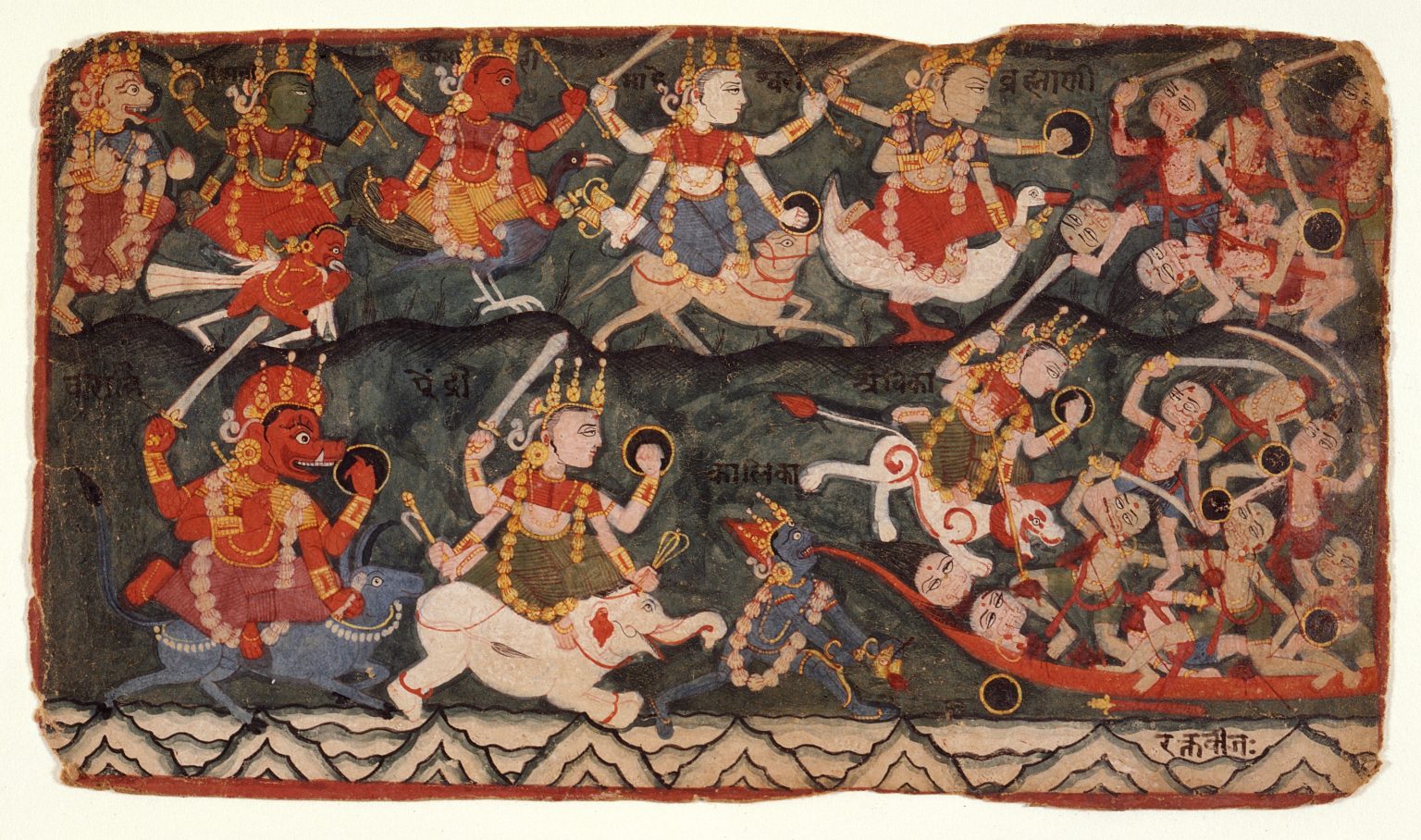
Source- Digital Temple of the Divine Mother. “Original Manuscripts – The Devi Mahatmya https://devimahatmya.com/original-manuscripts/
GUDI PADWA AND RELATED NEW YEAR FESTIVALS
Gudi Padwa is New Year’s Day for Maharashtrian Hindus and coincides with the commencement of the first day of Chaitra Navratri (also known as Mamma Magam or Ugadi). The Gudi is an iconic symbol of Gudi Padwa; literally a bamboo pole with a silk cloth of a vibrant shade, a garland and an inverted pot perched on top. The Gudi represents victory, peace and good fortune, and is also considered an ode to the Shalivahana era, celebrating the beginning of the era, as well as a harvest festival to usher in the arrival of spring.
As we noticed with Makar Sankranti, this theme of renewal and revivification is a common thread across many festivals running in parallel across India. While South Indians celebrate this time of year as Ugadi, the New Year, other parts of northern and eastern India have their own festivities to coincide with the universal renewal of the cosmos. It is the common underpinning philosophy of Indian thought, such as the belief in time being cyclical, in dharma prevailing, or in man being in harmony with the forces of Nature, that connects the differences between the numerous regions of India.[5]
CONCLUSION
Navratri, Gudi Padwa and New Year celebrations are more than just simple religion. They are complex mechanisms of cultural and cosmological memory that help us negotiate our place in time. As they have evolved over centuries, these celebrations reflect the very ancient and deeply scriptural roots that provide a framework for the distinctly Indian vision of time, space and human agency. The fact that these festivities have survived for thousands of years speaks not only to the power of Hindu culture to evolve and find expressions of deep spirituality in an ever-changing secular world but also to its ability to seamlessly merge the temporal with the sacred and transform mundane practices into timeless acts of harmony between the two.
BIBLIOGRAPHY
Doniger, Wendy. The Hindus: An Alternative History. New York: Penguin Press, 2009.
Eck, Diana L. India: A Sacred Geography. New York: Harmony Books, 2012.
Fuller, C. J. The Camphor Flame: Popular Hinduism and Society in India. Princeton: Princeton University Press, 1992.
Kinsley, David. Hindu Goddesses: Visions of the Divine Feminine in the Hindu Religious Tradition. Berkeley: University of California Press, 1986.
The Markandeya Purana. Translated by F. Eden Pargiter. Calcutta: Asiatic Society, 1904.
Author:
Arun Kumar
PhD Scholar
Dept- School of culture and creative expressions.
University- Dr. B. R. Ambedkar University Delhi
[1] David Kinsley, Hindu Goddesses: Visions of the Divine Feminine in the Hindu Religious Tradition (Berkeley: University of California Press, 1986), 95–110.
[2] The Markandeya Purana, trans. F. Eden Pargiter (Calcutta: Asiatic Society, 1904), Durga Saptashati, chapters 73–79.
[3] Diana L. Eck, India: A Sacred Geography (New York: Harmony Books, 2012), 142–150.
[4] Rachel Dwyer and Christopher Pinney, Pleasure and the Nation: The History, Politics and Consumption of Public Culture in India (New Delhi: Oxford University Press, 2001), 75–78; D. P. Dubey, Folk Dances of Gujarat (New Delhi: Publications Division, Government of India, 2009), 112–120.
[5] Diana L. Eck, India: A Sacred Geography (New York: Harmony Books, 2012), 136–150; C. J. Fuller, The Camphor Flame: Popular Hinduism and Society in India (Princeton: Princeton University Press, 1992), 37–60; Vasudha Narayanan, “Hinduism,” in The Blackwell Companion to Religion in America, ed. Philip Goff (Malden, MA: Blackwell Publishing, 2000), 214–230.