
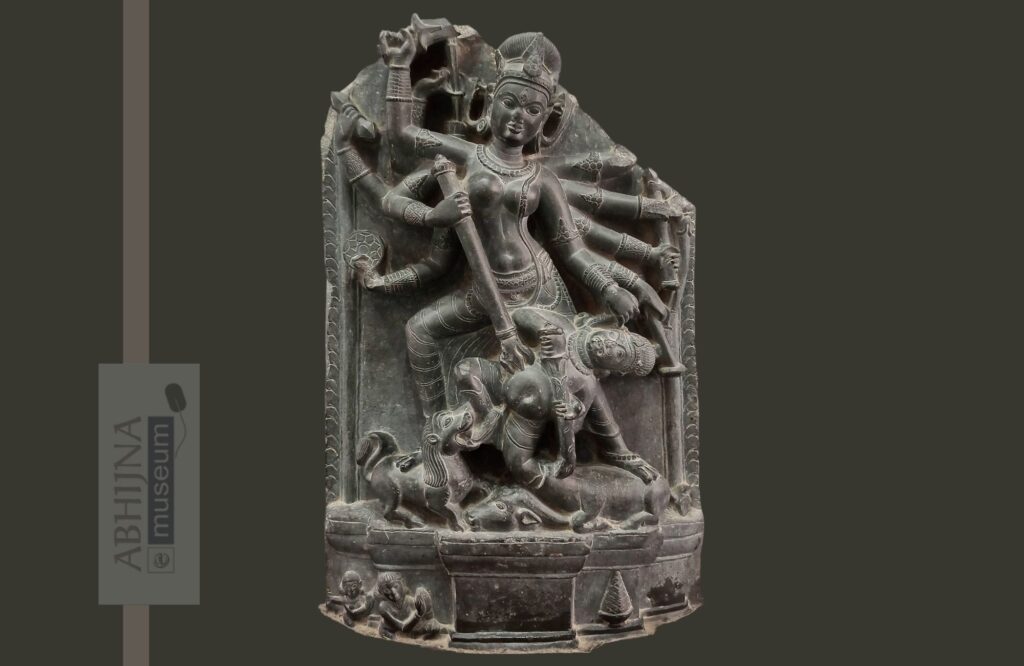
The sculpture represents the Hindu goddess Mahīṣāsuramardinī, one of the most celebrated manifestations of Goddess Durgā, depicting her triumph over the buffalo demon Mahīṣāsura. Carved in stone, the image exemplifies the mature sculptural traditions of early medieval India, where theological symbolism, narrative dynamism and artistic refinement were harmoniously integrated into sacred imagery. Although the precise provenance of the sculpture is unknown, its iconographic programme, stylistic characteristics and ornamental treatment suggest that it belongs to the Pāla–Sena sculptural tradition (c. 9th – 12th century CE) of eastern India, a period distinguished by sophisticated stone carving and elaborate representations of Brahmanical deities (Huntington, 1984; Harle, 1994).
The goddess occupies the centre of the composition in a commanding yet graceful posture, embodying both feminine beauty and divine power. She is depicted with eight arms (Aṣṭabhujā Durgā), signifying her transcendence over ordinary human limitations and her possession of the collective powers of the gods. According to the Devī Māhātmya, each deity presented Durgā with a divine weapon before her battle against Mahīṣāsura, making her multiple arms symbolic manifestations of cosmic energies united within a single supreme goddess (Coburn, 1984).
The principal right hand firmly grasps a long trident (triśūla), which penetrates the body of the emerging anthropomorphic demon. The trident, traditionally associated with Śiva, symbolises the destruction of ignorance, ego and evil, while simultaneously representing dominion over the three worlds and the three fundamental qualities (guṇas) of existence. The dramatic positioning of the weapon establishes the composition’s central visual axis and emphasises the decisive moment of divine victory.
The remaining hands, although partially damaged, originally held several divine attributes. The upper left hand appears to hold a discus (cakra), associated with Viṣṇu and representing the cosmic wheel of time and universal order. Another hand carries a bow, while one of the lower hands appears to grasp a sword or mace-like weapon, both signifying martial prowess and righteous warfare (dharma-yuddha). Some hands are now broken, yet their original positions continue to suggest the dynamic circular arrangement characteristic of Mahīṣāsuramardinī iconography, as prescribed in texts such as the Matsya Purāṇa, Agni Purāṇa, and Śilpaśāstras (Kramrisch, 1946).
The goddess is portrayed in an energetic stance with one leg firmly planted upon the subdued buffalo while the other stabilises her posture during combat. This dynamic pose effectively conveys movement and divine authority without sacrificing compositional balance. Unlike static devotional icons, the sculptor has successfully captured a climactic narrative moment, transforming the image into a visual representation of cosmic struggle.
Beneath the goddess lies the defeated buffalo demon Mahīṣāsura, depicted in his dual manifestation. The severed buffalo head occupies the lower register, while the anthropomorphic demon emerges from the decapitated body, a convention widely observed in Indian sculptural traditions. This transformation illustrates the narrative described in the Devī Māhātmya, in which Mahīṣāsura repeatedly changes form during his battle with the goddess before finally assuming human form as he is slain (Coburn, 1984). The demon’s contorted posture, bent limbs and upward gaze communicate both resistance and inevitable defeat before divine justice.
Adjacent to the buffalo appears the lion (siṃha), the vāhana (vehicle) of Durgā. Rather than functioning merely as a mount, the lion actively participates in the battle by attacking the demon, thereby reinforcing the goddess’s overwhelming martial power. Within Hindu iconography, the lion symbolises courage, sovereignty and royal authority, qualities that complement Durgā’s identity as the supreme protectress of cosmic order (dharma). The vigorous modelling of the animal, with its open jaws and alert posture, enhances the scene’s dramatic intensity.
The sculptor has carefully balanced martial energy with idealised feminine beauty. Durgā possesses a youthful oval face, gently arched eyebrows, elongated almond-shaped eyes and delicately modelled lips that convey serenity rather than aggression. This calm facial expression, despite the violence of the narrative, reflects an important theological principle in Indian art: divine action proceeds without emotional disturbance. The goddess remains composed because her destruction of evil is understood as an act of cosmic necessity rather than personal vengeance (Harle, 1994).
The figure is richly adorned with ornaments characteristic of early medieval Indian sculpture. She wears an elaborate kirīṭa-mukuṭa (conical crown), signifying divine sovereignty, while large circular ear ornaments, necklaces, armlets (keyūra), bracelets (kaṅkaṇa), girdles (mekhalā), and anklets enrich the image’s visual splendour. The transparent lower garment clings closely to the body, revealing the graceful anatomical modelling that typifies the sculptural ideals of eastern India. Fine incised lines define the drapery’s folds, while ornamental jewellery provides rhythmic visual accents throughout the composition.
Behind the principal figure is a carved architectural back slab (prabhāvali) that frames the deity and reinforces her sacred status. Although partially damaged, the back-slab originally contained decorative motifs and possibly attendant figures that established the divine setting. At the lower corners of the pedestal are diminutive donor or attendant figures shown in devotional attitudes, emphasising the relationship between the worshipper and the goddess. Such subsidiary figures are common features of Pāla-period sculpture and serve both compositional and devotional purposes (Huntington, 1984).
The pedestal itself is architecturally articulated into moulded sections that create visual stability while elevating the divine figure above the earthly realm. The inclusion of lotus motifs and ornamental mouldings further enhances the sculpture’s sacred character. Despite minor losses to several attributes and the upper background, the image remains remarkably well preserved, retaining much of its original iconographic clarity and sculptural refinement.
From an art-historical perspective, the sculpture exemplifies the mature phase of eastern Indian stone carving, characterised by balanced proportions, highly polished surfaces, refined anatomical modelling, and intricate ornamental detail. The harmonious integration of narrative movement, theological symbolism and idealised beauty reflects the sophisticated artistic vision achieved under the Pāla–Sena ateliers. The image also illustrates the increasing prominence of Śākta worship during the early medieval period, when the cult of the Great Goddess (Mahādevī) attained widespread popularity throughout the Indian subcontinent.
Iconographically, the sculpture transcends its narrative function as a representation of mythological combat. It embodies the triumph of dharma over adharma, of knowledge over ignorance, and of divine order over chaotic forces. Mahīṣāsura symbolises uncontrolled desire, arrogance and disorder, while Durgā represents the supreme feminine energy (Śakti) that restores cosmic equilibrium. Consequently, the image functioned not only as an object of worship but also as a powerful visual expression of Hindu philosophical concepts concerning creation, preservation and the cyclical victory of righteousness.
Collection: Coochbehar Rajbari Palace Museum, Coochbehar, West Bengal
References:
- Coburn, T.B. (1984) Devī Māhātmya: The Crystallisation of the Goddess Tradition. Delhi: Motilal Banarsidass.
- Harle, J.C. (1994). The Art and Architecture of the Indian Subcontinent. 2nd edn. New Haven, CT: Yale University Press.
- Huntington, S.L. (1984). The Pāla-Sena Schools of Sculpture. Leiden: E.J. Brill.
- Kramrisch, S. (1946). The Hindu Temple. 2 vols. Calcutta: University of Calcutta.
- Michell, G. (1988). The Hindu Temple: An Introduction to Its Meaning and Forms. Chicago: University of Chicago Press.
- Pal, P. (1986). Indian Sculpture: Volume I, circa 500 BC–AD 700. Los Angeles: Los Angeles County Museum of Art.