
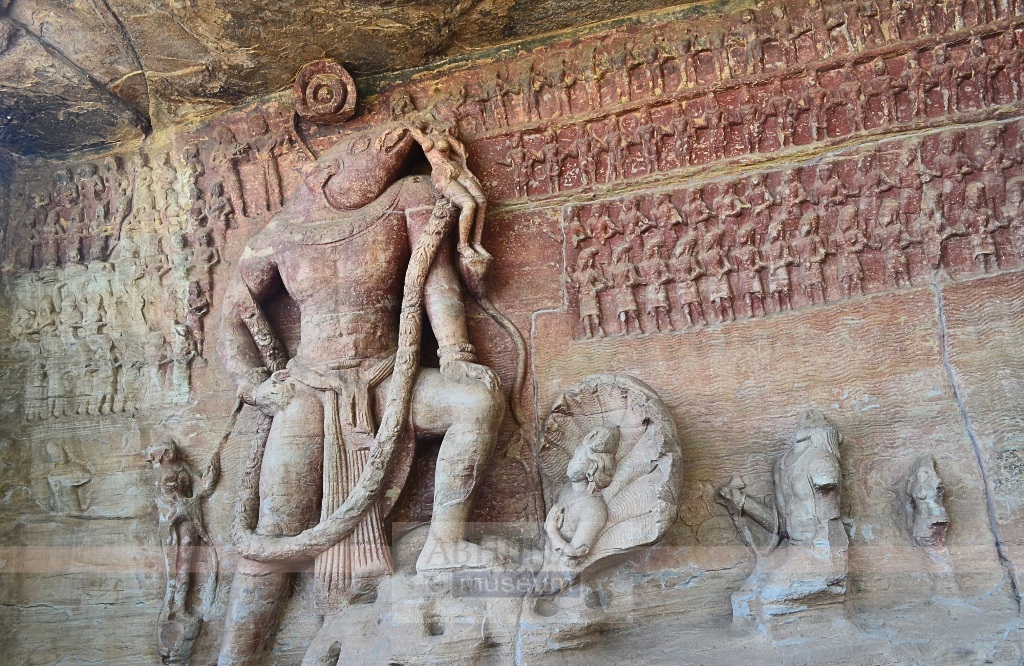
The colossal Varāha relief at Udayagiri Hills, near Vidisha in Madhya Pradesh, is widely regarded as one of the greatest masterpieces of early Indian sculpture. Executed during the reign of the Gupta emperor Chandragupta II Vikramāditya (c. 375–415 CE), the relief marks a decisive moment in the evolution of Hindu iconography, temple art, and royal ideology. Carved directly into the sandstone cliff of Cave 5, the sculpture depicts Viṣṇu in his Varāha (Boar) incarnation rescuing Bhūdevī (the Earth Goddess) from the cosmic waters after defeating the forces of chaos. More than a mythological illustration, the monument serves as a political and theological statement, visually proclaiming the Gupta king as the earthly representative of Viṣṇu, the divine preserver and restorer of cosmic order (dharma). Combining monumental scale, sophisticated iconography, inscriptions, and an exceptional natural setting, the Udayagiri Varāha panel occupies a pivotal position in the history of Indian art and religion.

Situated approximately 4 km from Vidisha and about 13 km from Sanchi, the Udayagiri Caves comprise a group of nearly twenty rock-cut sanctuaries excavated into a sandstone hill during the late fourth and early fifth centuries CE. The complex represents one of the earliest surviving examples of Hindu rock-cut temple architecture and includes shrines dedicated principally to Viṣṇu and Śiva, as well as one Jain cave. Unlike earlier Buddhist cave monasteries, the Udayagiri caves were conceived primarily as sacred Hindu spaces, marking an important transition in the architectural history of the Indian subcontinent. Their inscriptions directly associate the site with the Gupta emperor Chandragupta II, making Udayagiri the only major Hindu religious monument securely connected with a Gupta ruler through contemporary epigraphic evidence.
Among the monuments at Udayagiri, the colossal Varāha relief in Cave 5 stands as the artistic and ideological centrepiece of the complex. It is not merely a representation of a Purāṇic myth but a carefully orchestrated visual programme integrating religion, politics, cosmology, and kingship.

Historical Background:
The Udayagiri caves were excavated during a period often described as the Golden Age of the Gupta Empire, when literature, sculpture, architecture, astronomy, mathematics, and religious philosophy flourished. The reign of Chandragupta II Vikramāditya witnessed extensive royal patronage of Vaiṣṇavism while simultaneously encouraging artistic innovation and religious pluralism.
An inscription dated to Gupta Year 82 (401 CE) records the presence of the emperor’s minister Vīrasena, who supervised the excavation of one of the caves. This inscription provides invaluable historical evidence linking the monument directly with the Gupta court and demonstrates that the creation of the caves formed part of an imperial religious programme rather than merely local patronage.
Art historian Michael D. Willis has argued that Udayagiri functioned as a ceremonial landscape where royal authority was expressed through sacred geography. The selection of the Varāha myth, therefore, was deliberate: just as Viṣṇu restored the Earth from cosmic disorder, the Gupta emperor presented himself as the restorer of political and moral order throughout the realm.
Description of the Varāha Relief:
The monumental sculpture occupies the wall of Cave 5 and measures approximately 7 metres in width. Carved in high relief directly from the living rock, it portrays Varāha, the third avatāra of Viṣṇu, with a human body and the head of a wild boar.
The deity stands in a commanding tribhaṅga-inspired stance with one leg firmly planted upon the earth and the other elevated over a subdued Nāga (serpent), symbolising the subjugation of chaotic primordial forces. His muscular torso, broad shoulders, and expansive chest embody divine strength while retaining the calm dignity characteristic of Gupta sculpture.
Emerging gracefully from Varāha’s raised tusk is Bhūdevī, the Earth Goddess, whom he rescues from the cosmic ocean. Unlike later medieval representations, Bhūdevī is depicted with restraint and elegance, emphasising divine protection rather than dramatic movement.
Surrounding the principal figure is a vast assembly of divine beings, sages, celestial musicians, river goddesses, Nāgas, and attendants. These subsidiary figures transform the relief into a visual cosmos, witnessing the restoration of universal order.
The Udayagiri Varāha relief occupies a landmark position in the development of Indian sculpture.
Earlier Kuṣāṇa sculpture emphasised physical mass and frontal rigidity. By contrast, the Gupta sculptors achieved:
- harmonious proportions,
- controlled anatomical modelling,
- spiritual serenity,
- rhythmic composition,
- Integration of sculpture with architecture.
The Varāha relief demonstrates these characteristics with remarkable sophistication.
Unlike portable sculptures carved in sandstone or produced in metal, the relief is inseparable from the living cliff. The rock itself becomes sacred space, foreshadowing later achievements at Badami, Ellora and Mamallapuram. Rather than illustrating a single isolated figure, the sculptor created a monumental narrative in which every participant contributes to the theological message.
The composition establishes an ordered visual hierarchy:
- Varāha dominates the centre.
- Bhūdevī forms the emotional focus.
- Gods and sages acknowledge divine intervention.
- Nāgas represent conquered cosmic waters.
This integrated arrangement became a model for later Hindu sculptural programmes.
The iconography derives primarily from Vaiṣṇava mythology while simultaneously expressing Gupta political ideology.
- Varāha – The boar-headed form symbolises: divine strength, protection, restoration, cosmic renewal. Unlike an ordinary animal, the boar represents Viṣṇu’s intervention whenever cosmic order collapses.
- Bhūdevī – The Earth Goddess, clinging delicately to Varāha’s tusk, represents the rescued world. Her presence signifies fertility, stability and legitimate sovereignty.
- Nāga – The serpent beneath Varāha symbolises the primaeval waters and chaotic forces from which the Earth emerges.
- Celestial Assembly – The surrounding figures include: Brahmā, Śiva, sages, devas, river goddesses, gandharvas, nāgas and attendants. Their presence indicates universal recognition of Viṣṇu’s cosmic act.
Royal Symbolism:
Many scholars interpret one of the human figures near the relief as alluding to the Gupta emperor or his minister, reinforcing the association between divine and earthly sovereignty.
The Varāha myth has deep roots in Indian literature and evolved over several centuries.
- Vedic Sources: The earliest references occur in the Taittirīya Saṃhitā (7.1.5) and the Śatapatha Brāhmaṇa (14.1.2), where Prajāpati assumes the form of a boar to raise the Earth from the primordial waters. These accounts present the boar as a cosmogonic figure involved in the creation and stabilisation of the world.
- Epic Literature: Although the Mahābhārata contains references to Viṣṇu’s manifestations, the Varāha narrative becomes more fully developed in the later Vaiṣṇava tradition.
- Purāṇic Sources: The mature form of the myth appears in the Viṣṇu Purāṇa, the Bhāgavata Purāṇa, the Matsya Purāṇa, the Agni Purāṇa, and the Varāha Purāṇa. These texts describe the demon Hiraṇyākṣa dragging the Earth into the cosmic ocean, whereupon Viṣṇu incarnates as Varāha, defeats the demon, and restores Bhūdevī.
The Udayagiri relief reflects this later Purāṇic version while presenting it in a distinctly Gupta visual idiom.
Influence on Later Indian Art:
The iconography established at Udayagiri profoundly influenced later representations of Varāha throughout India, including:
- Eran (Madhya Pradesh)
- Badami (Karnataka)
- Aihole (Karnataka)
- Ellora (Maharashtra)
- Khajuraho (Madhya Pradesh)
- Chola temples of Tamil Nadu
While later images became increasingly elaborate, the Udayagiri sculpture remains the earliest monumental expression of the fully developed Varāha icon.
Conservation and Archaeological Importance:
Today, the Udayagiri Caves are protected by the Archaeological Survey of India and remain one of the most important archaeological sites of the Gupta period. In addition to the Varāha panel, the complex preserves inscriptions, early temple forms, water-management features, and sculptures of Viṣṇu, Śiva, Durgā, and Jain tīrthaṅkaras, making it an invaluable resource for the study of early Hindu art, religion, and statecraft.
Conclusion:
The Varāha relief at Udayagiri is much more than a monumental depiction of a Purāṇic legend. It represents the convergence of religion, political ideology, and artistic innovation during the Gupta period. Through its refined sculptural style, carefully structured iconography, and association with imperial patronage, the relief established enduring conventions for Hindu temple art. At the same time, it transformed the myth of Varāha into a powerful visual metaphor for righteous kingship and the restoration of cosmic order. More than sixteen centuries after its creation, the Udayagiri Varāha continues to stand as one of the defining monuments of India’s classical artistic heritage.
References:
- Agrawala, V.S. (1963) Gupta Art. Varanasi: Prithivi Prakashan.
- Harle, J.C. (1994) The Art and Architecture of the Indian Subcontinent. 2nd edn. New Haven: Yale University Press.
- Kramrisch, S. (1946) The Hindu Temple. 2 vols. Calcutta: University of Calcutta.
- Mitra, D. (1980). Udayagiri and Khandagiri. New Delhi: Archaeological Survey of India. (Note: this work concerns the Odisha caves and should not be confused with Udayagiri near Vidisha.)
- Michell, G. (1988). The Hindu Temple: An Introduction to Its Meaning and Forms. Chicago: University of Chicago Press.
- Willis, M.D. (2009). The Archaeology of Hindu Ritual: Temples and the Establishment of the Gods. Cambridge: Cambridge University Press.
- Williams, J.C. (1982) The Art of Gupta India: Empire and Province. Princeton: Princeton University Press.
Literary Sources:
- Eggeling, J. (trans.) (1900) Śatapatha Brāhmaṇa. Sacred Books of the East, Vols. 41–44. Oxford: Clarendon Press.
- Wilson, H.H. (trans.) (1840) The Vishnu Purana. London: John Murray.
Web Resources:
- District Administration, Vidisha – Udayagiri Caves
- Incredible India – Udayagiri Caves
- World History Encyclopedia – Vishnu as Varaha, Udayagiri Caves
- Michael D. Willis, *The Archaeology of Hindu Ritual* (Cambridge University Press)