
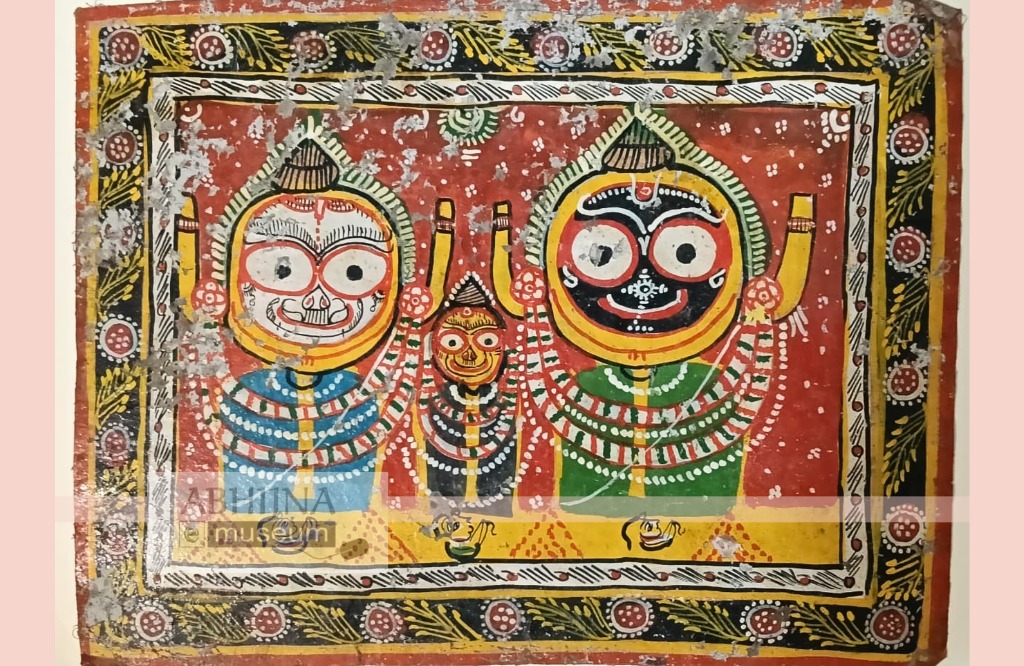
Patachitra of Odisha holds a unique position among the hereditary painting practices of eastern India, not only as a decorative folk art but also as a living ritual practice closely connected to the cult of Lord Jagannath at Puri. The word Patachitra is derived from the Sanskrit words pata, meaning cloth or canvas, and chitra, meaning picture. The artists who make them are called chitrakars, and they have painted on cloth, walls, and palm leaves according to ritual needs. The practice has continued for almost three centuries, with hereditary painter families centred in the heritage village of Raghurajpur near Puri and smaller production centres in Paralakhi Mundi, Chikiti, Dana Sahi, and Sonepur. What makes Patachitra different from similar regional practices is that its formal vocabulary, pigments, and iconographic conventions were originally created for a particular ritual purpose: to decorate the idols of the Jagannatha temple of Puri for Lord Jagannath.
The iconography of Jagannath, Balabhadra, and Subhadra has long been noted by scholars, including B. Mohanty, whose basic text on Odishan pata-paintings attributes this dominance to a pre-Aryan, tribal substratum underlying the cult of Jagannath. This article follows that comment by examining three festival days when the bond between painting and divinity is most apparent: Nava Kalevara, Banaka Lagi, and the Anasara period.

The Chitrakaras as Ritual Custodians
The painters of Odisha were mainly from the so-called low castes, with surnames such as Maharana, Mahapatra, Das, Subudhi, Bindhani, Paikaroy, and Dattamahapatra. They were not merely artisans hired to create religious images; during ritual ceremonies, they served as hereditary chitrakaras, or painters of sacred images of the Trinity, and were also required to paint them at regular intervals. Thus, responsibility for painting fell to these Chitrakaras for any art related to the Jagannatha Temple for a long time. Even the Dattamahapatra family of Odisha has a connection with the Savara tribe, whose association with the temple and its colouring rites is treated as original rather than derivative. Painting, therefore, in the context of Odisha and the Jagannatha temple in particular, is one of the mechanisms by which divinity is constituted and sustained. It is worth noting that creating a single image or portrait is often the work of more than one hand: the larger chitrakara family usually contributes to its creation, highlighting the family structure and guild-like way in which this tradition has been passed down from generation to generation.
Nava Kalevara: Painting as the Final Act of Embodiment
The most obvious expression of the intimacy between Patachitra and the Jagannath tradition is the Nava Kalevara (‘new body’) ritual, conducted every 12 years. During this sacred ritual, new images of the deities are carved from specially acquired wood, following strict sacred rites that transform the wood, or Daru, into structural images of the deities. The images are then layered with ritual pastes made from collected herbal products and soft clay, applied to the entire surface of the image, which is considered the flesh (Aswalagi or Khadilagi) of the deity. A cloth called Sri Kapada is then placed on top to create the skin. Natural pigments are applied to finalise the form of the image, and then the Brahma, or life-principle, is ceremoniously placed in the completed body. This process shows the role of painting in the cult: colour is not added to a completed sculpture but serves as a final act of embodiment, preparing the wooden form to receive divine presence. The chitrakara’s brush in this context serves a function similar to the sculptor’s chisel.
Banaka Lagi and the Discipline of Repainting
The Trinity of the Jagannatha temple fades in colour over time because of daily and periodic ablutions performed during worship, and therefore needs to be repainted at intervals. This traditional ceremony, called Banaka Lagi, is derived from the Sanskrit word varna, meaning colour, and follows a set of iconographic conventions. It depends on traditional colours such as conch-shell (Sankha) for white, musk (Kasturi) for yellow, saffron (Kesara) for orange, yellow arsenic (Haritala) and red ochre (Hingula) for red, all bound with gum sourced from the kaitha tree. Over the centuries, these naturally obtained materials have remained consistent as part of the Patachitra tradition that emerged outside the temple walls, creating a visual grammar defined by colour palette, figuration, and outline work.
Anasara and the Substitution of the Painted Image
The ritual occasion that most directly links Patachitra with Lord Jagannatha and the temple itself is the Anasara period. Days before the Rath Yatra, on an auspicious full moon day in the month of Jyestha, the Snana Yatra, or ceremonial bathing of the idols, is conducted. Customarily, 108 pots containing holy water are poured onto them, after which most of their colour is rinsed away, and they are believed to catch a divine fever. They are then withdrawn into seclusion within the Anasara Ghara, believed to be the sick room, to recover until the commencement of the Ratha Yatra.
During this resting period, devotees do not get access to the physical images of their Lords. The question then arises: who should be worshipped inside the temple in the absence of the three deities? The wooden images are replaced with painted panels of the Trinity, which are displayed for public worship. Three patas are made for the three deities: Sri Ananta Narayana pati for Lord Jagannath, Ananta Basudeva pati for Lord Balabhadra, and Bhubaneswari pati for Goddess Subhadra. The temple authorities task the chitrakars with creating these Ananta patis during the month of Jyeshtha. A group of chitrakars under the supervision of the head chitrakar creates these patis to be worshipped by everyone during the period of Anasara.
These painted representations follow the prescribed iconographical details of the deity and are not considered mere substitutes. They are seen as embodiments of the absent divinities and are equally revered and worshipped as the original wood-made idols. Therefore, this tradition of the Anasara period is explicitly connected to the ritual authority of the Patachitra tradition of Odisha, which also links the art tradition to the important religious festival, Ratha yatra, associated with the Jagannatha temple.
Royal Patronage and the Expansion Beyond the Temple
With local feudatory rulers building smaller temples to worship Lord Jagannatha in their own kingdoms, the reach of the chitrakars widened, helping to patronise the Patachitra tradition in Odisha. These rulers granted lands or jagirs to hereditary chitrakara families, who painted Sri Jagannath Patis and decorated temple walls, palace interiors, houses, and, most importantly, the Ratha Yatra ceremonial chariots. This arrangement is also ancient according to textual evidence. The chronicle of Puri, called the Madala Panji, along with the manuscript called Karmangi, documents the hereditary chitrakaras since at least the fourteenth-century reign of King Narasimha Deva IV. Their recorded responsibilities include decorating Ratha Yatra chariots and the boats used in the Chandan Yatra, as well as making certain ritual paintings, namely the Dasavatara Patis and Kandarpa Patis, both of which are associated with Lord Jagannatha.
The Repertoire of Pata-Painting
Gradually, a ritual-based art form evolved into an individual art form with a wider range of themes. Scholars have grouped the Odisha Patachitra tradition into six broad categories, which are: a) Sri Jagannatha Patis, b) epics-related Patis, c) folk narratives, d) Brata paintings (ritual paintings), e) paintings of fauna and flora, and f) Kandarpa Patis (erotic themed patachitras). The narrative paintings, mostly of Krishna’s Rasalila, the battle between Rama and Ravana, the burning of Lanka by Hanuman, or the cosmic Viswarupa of Krishna, illustrate the development of narrative and compositional sophistication in the tradition, which emerged from temple obligations and was transferred to the portable cloth surface.
Conclusion
Read against its ritual origins, Patachitra resists easy classification as a folk or decorative art existing alongside the worship of Jagannath. It is better understood as an art form generated from within that worship: the same hands, the same prescribed pigments, and the same iconographic discipline that transforms carved wood into living deity during the Nava Kalevara, that renew the Trinity’s painted surface through Banaka Lagi, and that stand in for the withdrawn deities during Anasara in the days before the Ratha Yatra, are the hands and conventions that produced the independent scroll-painting tradition now recognised well beyond Odisha. The chariot festival of Puri, so often described in terms of its monumental wooden chariots and its immense public procession, thus rests equally upon a quieter but no less essential visual practice — one in which the image, painted according to inherited rule, is treated not as representation but as presence.
References:
- Mohanty, B. Pata Paintings of Orissa, Ministry of Informatics and Broadcasting, Govt. of India. 1984.
- https://www.shreekhetra.com/anasara.html
- Das, Monalisa, A detailed study on Pattachitra Painting: The Heritage artwork of Raghurajpur, Odisha https://www.journalijdr.com/sites/default/files/issue-pdf/27333.pdf.