The bronze sculptures of the elephant, rhinoceros, bullock-cart and water buffalo from the Daimabad Bronze Hoard rank among the most extraordinary prehistoric metal artefacts discovered in South Asia. Unearthed accidentally in 1974 at the Chalcolithic site of Daimabad in Maharashtra, these sculptures constitute three of the four celebrated bronzes that have profoundly influenced scholarly understanding of Late Harappan metallurgy and the geographical extent of Harappan cultural traditions into the Deccan Plateau. Their monumental size, technical sophistication, naturalistic modelling, and engineering features distinguish them from other known Bronze Age sculptures of the Indian subcontinent. Despite ongoing debates over their chronology and cultural affiliation, the Daimabad bronzes remain among the finest surviving examples of prehistoric Indian metalwork and are now preserved in the National Museum, New Delhi.

Introduction:
The Daimabad Bronze Hoard occupies a unique position in the archaeology of South Asia. Unlike the relatively small bronze figurines recovered from the urban centres of Harappa and Mohenjo-Daro, the Daimabad bronzes are monumental, solid-cast sculptures that collectively weigh more than 60 kilograms. The hoard comprises four independent sculptures:
- Bullock-cart with driver
- Elephant
- Rhinoceros
- Water buffalo
While the bullock-cart has often received the most scholarly attention for its complexity, the three animal sculptures are equally significant. They demonstrate exceptional mastery of bronze casting and provide valuable evidence for prehistoric representations of wild and domesticated fauna in the Indian subcontinent. Their artistic quality and engineering sophistication indicate the existence of highly specialised metalworkers during the Late Bronze Age.

Discovery of the Daimabad Bronze Hoard:
The hoard was discovered in 1974 by a local farmer, Chhabu Laxman Bhil, while digging near the Chalcolithic mound at Daimabad on the left bank of the Pravara River in present-day Ahilyanagar (formerly Ahmednagar), Maharashtra. The discovery was subsequently reported to the Archaeological Survey of India (ASI), leading to renewed archaeological investigations under S. R. Rao and extensive excavations directed by S. A. Sali between 1976 and 1979.
Excavation revealed that Daimabad possessed one of the longest Chalcolithic occupational sequences in western India, comprising five cultural phases:
- Savalda Culture
- Late Harappan Culture
- Daimabad Culture
- Malwa Culture
- Jorwe Culture
This sequence established Daimabad as a crucial archaeological site for understanding interactions between the Harappan Civilisation and Chalcolithic communities of the Deccan.
The Bronze Elephant:
The elephant sculpture stands upon a rectangular cast platform supported by four pierced brackets originally designed to receive axles. Although its wheels are no longer preserved, the engineering indicates that the figure was conceived as a movable object.
Unlike later historic representations of elephants associated with royal processions or warfare, the Daimabad elephant is represented in a calm standing posture. Its rounded body, gently curving trunk, broad forehead, and simplified ears display a combination of naturalistic observation and stylised abstraction.
The sculptor deliberately emphasised the animal’s mass and stability rather than anatomical detail. This monumental treatment successfully conveys the elephant’s physical strength and dignity while maintaining structural integrity during casting.
The elephant occupies an important place in South Asian iconography from prehistoric times onward. Within the Harappan world, elephant motifs appear on seals, terracotta objects, and other artistic media, suggesting familiarity with the species and perhaps symbolic associations related to power, abundance, or the natural landscape.
The Bronze Rhinoceros:
The rhinoceros represents one of the most distinctive sculptures within the hoard. Standing on two parallel bars connected to solid wheels, the figure exhibits remarkable economy of form while preserving essential anatomical features.
The artist successfully captured:
- the elongated body,
- thick neck,
- projecting snout,
- erect ears,
- heavy limbs,
- and massive stance.
Although surface modelling is restrained, the sculpture unmistakably evokes the Indian one-horned rhinoceros (Rhinoceros unicornis).
The rhinoceros frequently appears on Indus seals and is widely regarded as one of the characteristic wild animals represented in Harappan iconography. The Daimabad sculpture therefore demonstrates continuity between Harappan artistic traditions and their regional expression in the Deccan.
Unlike decorative representations, the sculpture projects physical power and controlled movement through balanced proportions and simplified modelling.

The Bronze Water Buffalo:
The water buffalo stands upon a rectangular wheeled platform supported by four solid disc wheels.
Among the four Daimabad bronzes, the buffalo displays perhaps the greatest degree of anatomical realism. The sculptor carefully rendered:
- muscular shoulders,
- broad torso,
- lowered head,
- powerful neck,
- strongly curved crescent-shaped horns,
- sturdy limbs.
The massive horns immediately distinguish the animal from the humped zebu bulls represented on the bullock-cart.
The buffalo occupied an important position within Harappan subsistence economies, serving as both a source of agricultural labour and a symbol. Buffaloes occur repeatedly on Indus seals and terracotta figurines, indicating their economic and cultural importance.
The wheeled platform suggests that the sculpture may have been designed either as a movable ceremonial object or as a prestige object incorporating mechanical movement.
The Bronze Bullock-Cart:
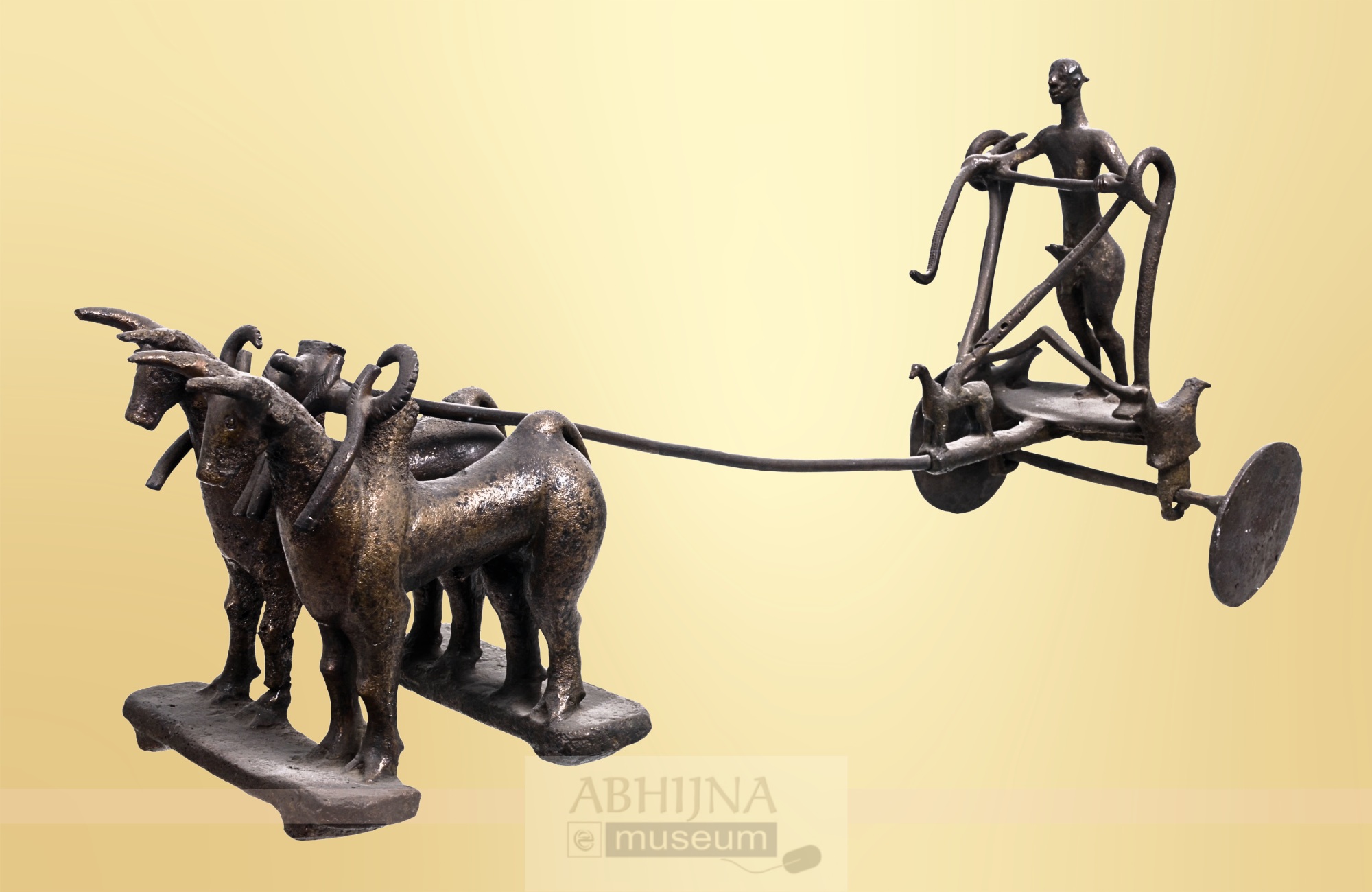
The sculpture depicts two powerful Bos indicus (zebu) bulls harnessed to a two-wheeled cart by means of a long draw-pole. Standing upon the cart is a human driver whose outstretched arms appear to control the team through stylised reins.
Several artistic features deserve particular attention:
- carefully modelled muscular bodies of the bulls;
- pronounced shoulder humps characteristic of Indian zebu cattle;
- elegantly curved horns;
- elongated, rhythmic proportions;
- open-framework construction of the vehicle;
- Balanced composition that conveys movement despite the sculpture’s static form.
The cart employs solid disc wheels rather than spoked wheels. As a result, this feature distinguishes it from the horse-drawn war chariots of the second millennium BCE and supports its interpretation as a practical bullock cart used for transport or ceremonial purposes.

Iconography and Symbolism of Bronze Bullock-Cart:
The iconography of the bullock-cart reflects fundamental aspects of Bronze Age life.
The Zebu Bull: The humped bull occupies a prominent place throughout Harappan art. It appears on seals, terracotta figurines, painted pottery, and bronze sculptures. At Daimabad, the bull is portrayed not merely as an animal but as an indispensable partner in agricultural production and transport.
The emphasis on powerful shoulders, pronounced humps, and curved horns conveys physical strength and endurance, qualities essential for draught animals.
The Driver: The standing driver transforms the sculpture into a narrative composition. Rather than producing an isolated animal figure, the artist depicts coordinated human activity, illustrating the relationship between people, domesticated animals, and technology.
The vehicle itself symbolises mobility, trade, communication, and the agricultural economy. More broadly, Harappan civilisation depended upon efficient transport systems linking urban centres with rural settlements and distant trading networks. Archaeological excavations throughout the Indus region have yielded numerous terracotta models of carts, but no other known example approaches the technical sophistication or sculptural complexity of the Daimabad bronze.
Metallurgical Achievement:
The Daimabad animal sculptures represent one of the highest achievements of prehistoric Indian metallurgy.
Scholars generally agree that they were manufactured using the lost-wax (cire perdue) casting technique. This sophisticated process required:
- modelling in beeswax,
- clay mould preparation,
- controlled firing,
- bronze casting,
- removal of mould,
- cold finishing and polishing.
The sculptures are solid cast, unlike many later hollow bronzes, making their successful production particularly impressive.
Chemical analyses have shown that the alloy consists primarily of copper with arsenic and minor quantities of tin. These findings became central to debates concerning their chronology because comparable arsenical bronzes are uncommon within securely dated Harappan assemblages.
Iconography and Symbolism:
The selection of three large animals is unlikely to have been arbitrary.
Each occupies an important ecological and symbolic position within the Indian subcontinent:
- Elephant – strength, forest environment, authority.
- Rhinoceros – wilderness, resilience, riverine landscapes.
- Water buffalo – agriculture, fertility, economic productivity.
All three species are represented in Harappan art, particularly on seals, indicating their significance within Bronze Age visual culture. Rather than serving as mere animal studies, the sculptures likely conveyed broader concepts about the natural world and the relationships among humans, animals, and the environment. Unlike later Hindu iconography, however, there is currently no archaeological evidence linking these sculptures directly to specific deities or ritual practices.
The Daimabad bronzes have generated one of the longest-standing debates in Indian archaeology.
Late Harappan Attribution:
Based upon archaeological context, ceramic associations, and excavation evidence, S. A. Sali (1986) concluded that the bronzes belong to the Late Harappan occupation of Daimabad. This interpretation was supported by S. R. Rao, M. N. Deshpande, and M. K. Dhavalikar, who regarded the sculptures as evidence for the southern expansion of Harappan cultural traditions.
Metallurgical Debate:
A different interpretation emerged from metallurgical analyses undertaken by D. P. Agrawal, R. V. Krishnamurthy, and Sheela Kusumgar, who observed unusually high arsenic concentrations in the alloy. On this basis, they questioned a direct Harappan attribution and suggested that the bronzes might belong to a later Chalcolithic or even early historic technological tradition.
Although this debate remains unresolved, many recent scholars favour describing the sculptures as products of a Late Harappan or Harappan-influenced Chalcolithic tradition, recognising both their archaeological context and their distinctive regional character.
Museum Display and Significance
The elephant, rhinoceros, bullock-cart and water buffalo are currently displayed at the National Museum, New Delhi, forming one of the most important groups of prehistoric bronze sculptures in India. Their display highlights the technological innovation, artistic imagination, and ecological awareness of Bronze Age communities inhabiting the Deccan, as well as their connections with the broader Harappan cultural sphere.
Conclusion:
The elephant, rhinoceros, and water buffalo from the Daimabad Bronze Hoard stand as exceptional achievements of prehistoric South Asian metallurgy and sculpture. Their monumental scale, sophisticated casting technology, and carefully observed animal forms demonstrate that metalworkers operating within the Late Harappan or Harappan-influenced cultural milieu possessed advanced technical knowledge and artistic vision. Although debates over chronology and cultural affiliation continue, these bronzes remain among the most compelling testimonies to the ingenuity of Bronze Age craftsmen and to the enduring importance of animal imagery in the archaeological heritage of the Indian subcontinent.
References:
- Agrawal, D.P., Krishnamurthy, R.V. and Kusumgar, S. (1978) ‘Fresh chemical data and the cultural affiliation of the Daimabad bronzes’, Archaeo-Physika, 10, Proceedings of the 18th International Symposium on Archaeometry and Archaeological Prospection, Bonn.
- Allchin, B. and Allchin, R. (1982) The Rise of Civilisation in India and Pakistan. Cambridge: Cambridge University Press.
- Dhavalikar, M.K. (1982) ‘Daimabad Bronzes’, in Possehl, G.L. (ed.) Harappan Civilisation: A Contemporary Perspective. Warminster: Aris & Phillips, pp. 362–366.
- Dhavalikar, M.K. (1993) ‘Daimabad Bronzes’, in Possehl, G.L. (ed.) Harappan Civilisation: A Recent Perspective. New Delhi: Oxford & IBH Publishing, pp. 422–426.
- Kenoyer, J.M. (1998) Ancient Cities of the Indus Valley Civilisation. Karachi: Oxford University Press.
- Possehl, G.L. (2002). The Indus Civilisation: A Contemporary Perspective. Walnut Creek, CA: Alta Mira Press.
- Sali, S.A. (1986) Daimabad, 1976–79. Memoirs of the Archaeological Survey of India No. 83. New Delhi: Archaeological Survey of India.
- Singh, U. (2008). A History of Ancient and Early Medieval India. New Delhi: Pearson Education.
- Wheeler, R.E.M. (1968) The Indus Civilisation. 3rd ed. Cambridge: Cambridge University Press.
Web Resources:
- National Museum, New Delhi. Official Website. Available at: https://nationalmuseumindia.gov.in/ (Accessed: 12 July 2026).
- (2025) Daimabad Bronzes. Available at: https://imp-art.org/articles/daimabad-bronzes/ (Accessed: 12 July 2026).
- Google Books. Daimabad, 1976–79 by S. A. Sali. Available at: https://books.google.com/books/about/Daimabad_1976_79.html (Accessed: 12 July 2026).
- National Gallery of Art. The Sculpture of India, 3000 BC–1300 AD. Available at: https://www.nga.gov/content/dam/ngaweb/research/publications/pdfs/sculpture-of-india.pdf (Accessed: 12 July 2026).