
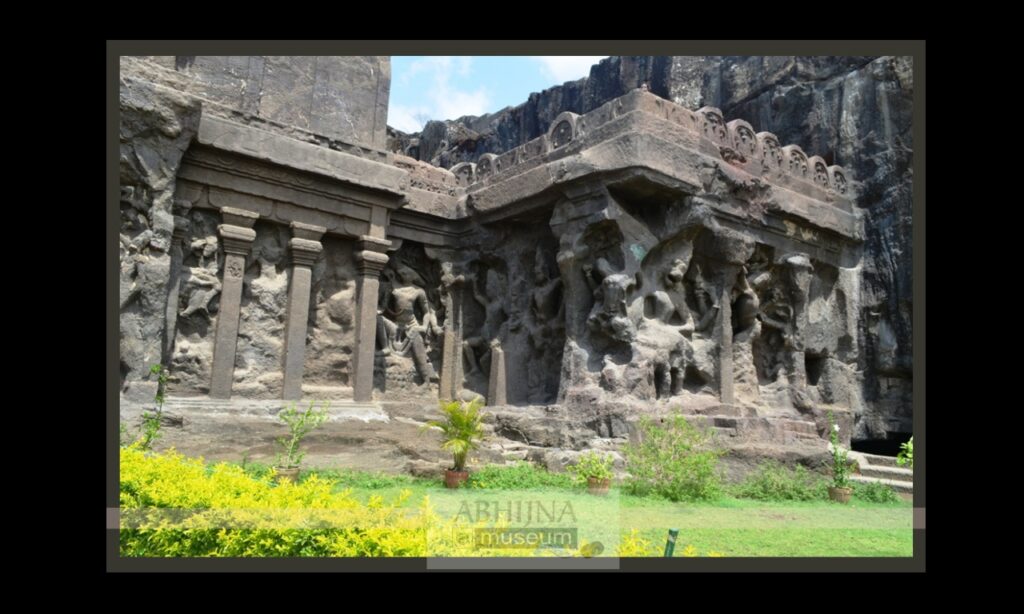
Introduction:
The Ellora Caves, locally known as Verul Leni, are a significant achievement in Indian rock-cut architecture and are recognised as one of the world’s foremost archaeological monuments. Located approximately 30 km northwest of Aurangabad (Chhatrapati Sambhajinagar) in Maharashtra, the site holds a distinguished place in India’s cultural history due to its artistic, religious, and technological significance. The complex is internationally acclaimed for the Kailasa Temple (Cave 16), the largest monolithic rock-cut monument in the world, carved from a single basalt outcrop. Ellora is designated as a UNESCO World Heritage Site for its outstanding representation of artistic excellence, religious pluralism, and cultural continuity in ancient India (UNESCO, 2024).

In contrast to many other Indian rock-cut monuments, Ellora maintains a continuous sequence of Buddhist, Brahmanical (Hindu), and Jaina excavations spanning nearly six centuries. Collectively, these monuments exemplify the coexistence of diverse religious traditions and reflect the spirit of tolerance characteristic of early medieval Indian society. The architectural ensemble demonstrates both the evolution of religious thought and the technological expertise of ancient Indian craftsmen, who transformed volcanic rock into monumental temples, monasteries, and shrines of significant artistic value (Archaeological Survey of India, 2023).

Geological Setting and the Cultural Landscape:
The caves were excavated into the basaltic formations of the Deccan Traps, one of the world’s largest volcanic provinces, formed by successive lava flows during the late Cretaceous, approximately 65 million years ago. Weathering of these volcanic deposits created a series of stepped escarpments and terraces, providing ideal geological conditions for large-scale rock excavation. The fine-grained basalt found at Ellora possessed exceptional qualities for sculptural work: it was sufficiently soft during excavation yet hardened upon exposure to the atmosphere, ensuring the long-term durability of the monuments (ASI, 2023).

Geological features present at the site, such as horizontal lava flows, vertical joints, and ancient volcanic channels, significantly influenced the planning and construction of the caves. Ancient architects exhibited advanced knowledge of basalt’s properties by selecting rock layers and utilising natural joints to facilitate excavation and minimise structural instability. This expertise reduced labour demands and contributed to the engineering precision observed throughout the complex.
The caves are situated on the western escarpment of the Charanandri Hills, within the Sahyadri mountain range. Several seasonal streams, including the prominent Elaganga River, descend from these hills and are especially active during the monsoon season. The surrounding landscape, marked by dense vegetation, waterfalls, and rugged basalt cliffs, enhances the site’s aesthetic and spiritual atmosphere and likely influences its role as a religious centre.

Early Human Occupation and Historical Context:
Archaeological evidence indicates that the Ellora region has been continuously occupied since prehistoric times. Stone tools from the Upper Palaeolithic and Mesolithic periods, together with Chalcolithic remains discovered in the surrounding region, attest to prolonged human settlement, predating the commencement of cave excavation. These discoveries suggest that the area formed part of an important cultural landscape extending across the Deccan Plateau (ASI, 2023).
During the early historic period, the region fell within the sphere of the Satavahana dynasty, whose capital at Pratishthana (modern Paithan) controlled extensive trade networks connecting western Indian ports with the interior Deccan. Ellora occupied a strategic position along one of these ancient commercial routes linking ports such as Sopara, Kalyan and Chemula with inland urban centres including Paithan, Ter and Bhokardan. Although no major rock-cut activity occurred at Ellora during the Satavahana rule, its location along these flourishing trade corridors later contributed to its emergence as an important religious and cultural centre.

Excavation at Ellora began in the 6th century CE, coinciding with the decline of artistic activity at Ajanta. Over the following centuries, successive dynasties—including the Kalachuris, Early Chalukyas, Rashtrakutas, Later Chalukyas, and Yadavas—provided direct or indirect patronage for the cave complex. This ongoing support established Ellora as one of India’s largest concentrations of religious monuments, integrating Buddhist monasteries, Hindu temples, and Jaina sanctuaries within a unified sacred landscape.
The chronological development of Ellora broadly spans the sixth to the twelfth centuries CE. Of the nearly 100 excavations identified in the surrounding hills, 34 caves constitute the principal monumental complex visited today. These include twelve Buddhist caves (1–12), seventeen Brahmanical caves (13–29) and five Jaina caves (30–34). Together, they document more than five centuries of continuous artistic innovation and religious interaction, making Ellora an unparalleled testimony to India’s pluralistic cultural heritage.

Historical Development, Religious Patronage and the Evolution of the Ellora Caves:
The development of the Ellora Caves spans nearly six centuries of continuous religious, artistic, and political activity in the Deccan. Unlike other Indian rock-cut sites typically associated with a single religious tradition, Ellora became a unique sacred landscape where Buddhism, Brahmanism (Hinduism), and Jainism coexisted. The site’s architectural sequence illustrates both the chronological progression of Indian rock-cut architecture and the religious tolerance prevalent in early medieval India (Michell, 2000).
Royal Patronage and Political Context:
Although inscriptional evidence at Ellora is comparatively limited, the available archaeological, stylistic and epigraphic data permit the reconstruction of the site’s historical development. The earliest excavations are generally attributed to the Kalachuris of Mahismati, whose political influence extended into parts of present-day Maharashtra during the 6th century CE. Certain architectural characteristics also suggest that the Early Chalukyas of Badami may have contributed to the development of several monuments before the emergence of Rashtrakuta power (Harle, 1994).
A pivotal phase in Ellora’s history took place under the Rashtrakuta dynasty during the 8th and 9th centuries CE. The Rashtrakutas became a dominant imperial power in peninsular India after displacing the Chalukyas and consolidating control over the Deccan. Their rule was marked by substantial investment in monumental architecture, which established Ellora as a major centre of religious and artistic activity in South Asia.
One of the few surviving inscriptions from the site records the name of Dantidurga (c. 753–757 CE), the founder of the Rashtrakuta imperial authority, whose inscription appears on the rear wall of the mandapa of Cave 15 (Dasavatara Cave). Even more significant is the attribution of the magnificent Kailasa Temple (Cave 16) to his successor Krishna I (c. 757–783 CE). A copper-plate inscription issued during the reign of Karka II describes the monument in highly poetic language, praising its extraordinary beauty and suggesting that even celestial beings regarded it as a divine rather than a human creation. Such literary testimony reflects both the political ambitions of the Rashtrakutas and the immense prestige associated with monumental temple construction (ASI, 2023).
Following the decline of the Rashtrakutas, the region came under the control of the Later Chalukyas of Kalyani and subsequently the Yadavas of Devagiri. Stylistic analysis indicates that the Jaina caves were excavated during this later phase. Numerous Jain sculptures recovered from Devagiri and neighbouring settlements further support the continuation of royal patronage towards Jain religious institutions during the eleventh and twelfth centuries. The coexistence of monuments from three religious traditions across successive dynasties illustrates the pluralistic character of medieval Deccan society, in which political authority frequently transcended sectarian boundaries.
Religious Diversity and Architectural Phases:
The Ellora complex consists of 34 principal excavations arranged along a basalt escarpment that extends for nearly 2 kilometres. The monuments are organised according to religious affiliation rather than chronology, with the Buddhist caves occupying the southern section, the Brahmanical monuments dominating the central portion, and the Jaina excavations situated towards the northern end. This spatial organisation reflects the gradual expansion of the complex over several centuries while preserving the distinct identities of each religious community.
The twelve Buddhist caves (Caves 1–12) represent monasteries (viharas) and prayer halls (chaityas) associated primarily with Mahayana and later Vajrayana Buddhism. Unlike the earlier Hinayana monuments of western India, these excavations display increasingly elaborate iconographic programmes dominated by colossal images of the Buddha, Bodhisattvas and female divinities such as Tara. Cave 10, commonly known as the Vishvakarma or Carpenter’s Cave, represents one of the finest surviving chaitya halls in India. Its vaulted ceiling, monumental seated Buddha, and carefully proportioned interior demonstrate the culmination of Buddhist rock-cut architecture in the western Deccan.
The Brahmanical caves (Caves 13–29) constitute the largest and most ambitious phase of construction at Ellora. These monuments introduced increasingly sophisticated architectural planning, elaborate sculptural programmes and innovative engineering techniques. Their iconography draws extensively on the Ramayana, the Mahabharata, and the Puranas, presenting complex theological narratives centred on Shiva, Vishnu, Durga, and other major Hindu deities. Among these monuments, the Ramesvara Cave (Cave 21) displays elegant sculptural compositions depicting river goddesses, celestial attendants and scenes from Shaiva mythology, while Dhumar Lena (Cave 29) demonstrates clear artistic connections with the famous cave temples of Elephanta.
The Jaina caves (Caves 30–34) represent the final stage in the architectural evolution of Ellora. Although smaller in scale than the Brahmanical monuments, they exhibit exceptional refinement in sculptural execution. Delicately carved pillars, richly ornamented ceilings, elaborate shrine façades and surviving mural paintings illustrate the aesthetic preferences of the Digambara Jaina tradition. The restrained elegance of these monuments contrasts with the monumental grandeur of the Kailasa Temple while maintaining the high artistic standards that characterise the entire Ellora complex.
The Kailasa Temple: The Zenith of Indian Rock-Cut Architecture:
The architectural climax of Ellora is undoubtedly the Kailasa Temple (Cave 16), universally recognised as one of the greatest engineering achievements of the ancient world. Unlike conventional rock-cut caves excavated horizontally into cliff faces, the Kailasa Temple was carved vertically from the summit of a massive basalt outcrop. Ancient craftsmen removed an estimated 200,000 tonnes of rock before sculpting the freestanding temple from the remaining monolith. This technique required extraordinary planning and precision because any structural error during excavation would have been irreversible (Michell, 2000).
Dedicated to Shiva, the temple symbolically recreates Mount Kailasa, the deity’s mythical abode. The entire architectural composition reflects the principles of Dravidian temple architecture while also demonstrating the creative possibilities of monolithic excavation. The complex includes a monumental gateway (gopura), a detached Nandi pavilion, a towering vimana, subsidiary shrines, circumambulatory passages, pillared halls, and sculptured galleries, all carved from a single rock mass.
The sculptural programme of the Kailasa Temple represents one of the most comprehensive visual expressions of Hindu mythology in India. Narrative panels illustrating episodes from the Ramayana and the Mahabharata coexist with monumental representations of Shiva in his various manifestations. Among the most celebrated compositions is the dramatic depiction of Ravana attempting to lift Mount Kailasa, in which the dynamic movement of the figures, sophisticated modelling, and emotional intensity exemplify the highest achievements of early medieval Indian sculpture. Equally remarkable are the monumental elephants and lions carved around the temple plinth, which symbolically support the celestial mountain while enhancing the illusion of a constructed rather than excavated monument.
The Kailasa Temple is not solely an architectural accomplishment; it also reflects the political ambitions of the Rashtrakuta rulers, the technical proficiency of Indian craftsmen, and the religious vision of medieval Hinduism. Its integration of architecture, sculpture, engineering, and sacred symbolism has established its status as a significant masterpiece of world heritage and a pinnacle of Indian rock-cut architecture.
Architectural and Iconographic Significance:
The Ellora Caves represent the culmination of India’s rock-cut architectural tradition, reflecting more than five centuries of continuous artistic experimentation and technological innovation. While the caves belong to three distinct religious traditions, they exhibit a remarkable continuity in architectural planning, sculptural technique and craftsmanship, suggesting that successive generations of artisans shared common technical knowledge despite working under different religious patronage. This continuity transformed Ellora into an unparalleled artistic landscape in which architecture, sculpture, and religious symbolism were integrated into a unified visual narrative.
The Buddhist monuments illustrate the transition from the relatively austere monastic architecture of earlier centuries to the increasingly elaborate iconography associated with Mahayana and Vajrayana Buddhism. The monasteries (viharas) evolved from simple residential complexes into sophisticated religious institutions that included assembly halls, shrines, meditation cells, and monumental images of the Buddha. Cave 12 (Teen Tal), the largest Buddhist monastery at Ellora, demonstrates this architectural evolution through its three-storeyed plan, spacious pillared halls and extensive sculptural programme. Likewise, the Visvakarma Cave (Cave 10) represents one of the finest surviving chaitya halls in India, where the impressive seated Buddha placed before the stupa reflects the doctrinal shift towards devotional Buddhism. The sculptural repertoire includes numerous Bodhisattvas, celestial beings and female deities, revealing the growing complexity of Buddhist cosmology during the early medieval period.
The Brahmanical monuments exhibit an even greater degree of architectural innovation. These excavations abandoned the relatively restrained forms of earlier cave architecture in favour of monumental temple complexes that successfully replicated freestanding structural temples within a monolithic rock mass. This transformation reflects the increasing prominence of temple worship in Hindu religious practice during the early medieval period. The architectural vocabulary—including mandapas, garbhagrihas, circumambulatory passages, detached pavilions and towering vimanas—demonstrates an extraordinary understanding of structural principles despite being carved from living rock.
The sculptural decoration of the Brahmanical caves constitutes one of the richest visual repositories of Hindu mythology in South Asia. Monumental reliefs illustrating episodes from the Ramayana, Mahabharata and various Puranas not only served religious functions but also communicated complex theological concepts through highly expressive visual narratives. Among the finest examples are representations of Shiva as Nataraja, Mahishasuramardini slaying the buffalo demon, Vishnu in his various incarnations and the celebrated panel depicting Ravana attempting to lift Mount Kailasa. These compositions reveal exceptional mastery of proportion, movement and emotional expression while simultaneously conveying philosophical and devotional themes central to Hindu thought (Michell, 2000).
Although smaller in scale, the Jaina caves display extraordinary refinement and elegance. Their interiors are characterised by delicately carved pillars, intricately ornamented ceilings, finely executed shrine façades and carefully balanced sculptural compositions dedicated primarily to the Digambara tradition. Unlike the monumental grandeur of the Kailasa Temple, the Jaina monuments emphasise restraint, symmetry and meticulous ornamentation, qualities that reflect the religious ideals of asceticism and spiritual discipline. The surviving murals and painted decorations further demonstrate that sculpture and painting functioned together to create immersive sacred environments.
Ellora is a UNESCO World Heritage Site:
The exceptional artistic and cultural significance of Ellora received international recognition when it was inscribed on the UNESCO World Heritage List in 1983. The site meets several criteria for Outstanding Universal Value because it represents an unparalleled achievement of human creativity and illustrates the cultural and religious diversity of early medieval India (UNESCO, 2024).
Under Criterion (i), Ellora is recognised as a masterpiece of human creative genius. The Kailasa Temple, excavated entirely from a single rock, remains one of the greatest engineering accomplishments in architectural history. The precision required to remove enormous quantities of basalt while preserving structural integrity demonstrates an extraordinary level of technical planning and craftsmanship. Equally significant is the harmonious integration of architecture, sculpture and symbolic meaning, which transforms the monument into a complete artistic composition rather than merely a place of worship.
Criterion (iii) acknowledges Ellora as an exceptional testimony to the civilisation of ancient India. The uninterrupted sequence of monuments dating from the sixth to the twelfth centuries CE documents important developments in religion, philosophy, architecture, and artistic expression. Together, the caves provide invaluable evidence for understanding the political, social and cultural history of the Deccan during the early medieval period.
The site also fulfils Criterion (vi) because it symbolises the spirit of religious tolerance that characterised much of early medieval Indian society. The close proximity of Buddhist monasteries, Hindu temples, and Jaina sanctuaries demonstrates that multiple religious communities flourished within a shared sacred landscape under the patronage of successive ruling dynasties. Rather than representing isolated religious monuments, Ellora embodies a broader cultural dialogue that contributed significantly to India’s pluralistic heritage.
Conclusion:
The Ellora Caves represent a significant artistic and technological achievement, exemplifying the cultural vitality of early medieval India. Excavated over nearly six centuries, the monuments document the evolution of Buddhist, Brahmanical, and Jaina religious traditions and demonstrate notable advances in architecture, engineering, and sculpture. The integration of three religious traditions within a single monumental complex provides substantial evidence of coexistence and cultural interaction that shaped India’s historical development.
In addition to their religious significance, the caves preserve important information regarding political authority, artistic patronage, technological innovation, and social organisation during the early medieval period. The Kailasa Temple, in particular, is notable for its engineering and sculptural sophistication, and is regarded as a major monument created from living rock. Collectively, the Ellora Caves are more than archaeological remains; they serve as lasting expressions of India’s intellectual, artistic, and spiritual achievements.
Ongoing scientific conservation, responsible tourism management, and interdisciplinary research are essential for preserving this heritage for future generations. As both a national treasure and a World Heritage Site, Ellora remains a symbol of artistic excellence, religious pluralism, and the enduring legacy of Indian civilisation.
References:
- Archaeological Survey of India (2023) Ellora Caves. New Delhi: Archaeological Survey of India.
- Dehejia, V. (1972). Early Stone Temples of Orissa. New Delhi: Vikas Publishing House.
- Dehejia, V. (1997). Indian Art. London: Phaidon Press.
- Harle, J.C. (1994). The Art and Architecture of the Indian Subcontinent. 2nd New Haven, CT: Yale University Press.
- Huntington, S.L. (1985). The Art of Ancient India: Buddhist, Hindu and Jain. New York: Weatherhill.
- Michell, G. (1977). The Hindu Temple: An Introduction to Its Meaning and Forms. London: Elek Books.
- Michell, G. and Zebrowski, M. (1999) Architecture and Art of the Deccan Sultanates. Cambridge: Cambridge University Press.
- Soundara Rajan, K.V. (1981) Cave Temples of the Deccan. New Delhi: Archaeological Survey of India.
- Spink, W.M. (1981). Ajanta to Ellora. Mumbai: Marg Publications.
- Thapar, R. (2002). Early India: From the Origins to AD 1300. Berkeley: University of California Press.
- UNESCO (2024) Ellora Caves. Paris: UNESCO World Heritage Centre. Available at: https://whc.unesco.org/en/list/243 (Accessed: 26 June 2026).
- Burgess, J. (1883). Report on the Elura Cave Temples and the Brahmanical and Jaina Caves in Western India. London: Trübner & Co.
- Gupte, R.S. (1964). Ajanta, Ellora and Aurangabad Caves. Mumbai: D.B. Taraporevala Sons.
- Yazdani, G. (1946). Ajanta, Ellora and Aurangabad Caves. Oxford: Oxford University Press.
- Desai, D. (1987). Ellora Caves: Sculpture and Architecture. New Delhi: Oxford University Press (if consulted).
- https://asi.nic.in/pages/WorldHeritageElloraCaves (Accessed: 26 June 2026).
- https://www.worldhistory.org/article/874/ellora-caves/ (Accessed: 26 June 2026).